



Why “National Debt Crisis” Is Hard to Spot Until It’s Too Late
If you’ve ever felt like the national debt is either a ticking time bomb or… basically irrelevant, depending on which headline you read that day, you’re not alone. The frustrating part is that both vibes can sound reasonable in the moment.
A big reason is simple confusion about terms.
National debt is a point in time. It’s the total amount owed at a specific moment.
The deficit is a flow. It’s the yearly gap between what the government spends and what it collects in taxes and other revenue.
So a scary deficit headline does not automatically mean a debt crisis is imminent. In fact, America’s debt crisis can often be misunderstood due to these terminological confusions. And a “debt hit a new record” headline is almost always true in nominal dollars because the economy grows, prices rise over time, and governments refinance old debt while issuing new debt. New records are kind of the default setting.
This article has one goal. A history-based framework you can use as an investor to watch for stress signals of a Sovereign Debt Crisis. It is not a political argument and not a prediction. It’s more like, what would the investment and economic landscape look like if we wanted to know when the debt is starting to behave like a real market crisis?
And that last phrase matters. A “crisis” usually does not begin when the debt crosses some magic number. It begins when financing conditions change: when markets start demanding meaningfully higher yields for investors to buy our bonds; when inflation expectations get wobbly, and investors lose confidence that buying a bond today will not lead to a rate/opportunity loss tomorrow; when investors lose faith that economic growth can continue; or when the normal process of the treasury rolling debt over starts to feel less automatic and becomes questionable.
Do note that debt can be manageable for long stretches of time. Really, sometimes for decades (see the discussion on Japan below). The difference between “high debt but stable” and “high debt and unstable” is usually about the relationship between:
- Growth
- Inflation
- Interest rates
- Investor confidence in the bond market, especially U.S. Treasuries
To make this practical, we’re going to use a century-long lens to look at: wars, recessions, inflation eras, tax policy regime shifts – each of these events has left its mark on our national debt and the way we manage it.
In addition, with the advent of advanced technologies such as AI, there are emerging sectors like the AI infrastructure revolution that could potentially reshape our economic landscape and influence our national debt management strategies.
As we navigate this complex landscape, it’s crucial to keep an eye on investing opportunities in the AI sector, which may provide valuable insights into future economic trends and their potential impact on our national debt situation.
To paraphrase Mark Twain, history doesn’t repeat itself, but it does have favorite rhythms.
How Did We Get Here?
To understand today’s national debt dynamics, it’s essential to look back at the major spending programs, government responses, and changes in economic policy that shaped the current landscape. Over the past century, U.S. fiscal history has been marked by cycles of large-scale government spending—often in response to war, recession, crisis, or political opportunism—followed by debates over tax policy and monetary standards.
Major Spending Programs and Government Responses
- World War II and Postwar Expansion: The U.S. ran massive deficits to finance World War II. Debt soared relative to GDP, but was gradually reduced in the following decades through a combination of strong economic growth, moderate inflation, and restrained spending.
- Great Society & Vietnam Era: The 1960s saw new social programs, indexing them to inflation, and extreme military outlays, again increasing deficits. Economic growth helped offset much of this cost for a time, but ultimately it was not enough.
- 1970s Inflation Shock: Stagflation (rising inflation with sluggish growth) complicated debt management. Policymakers oscillated between stimulus and restraint, never yielding a cohesive and successful economic policy.
- 1980s Tax Cuts & Military Buildup: Major tax reductions (notably under President Reagan) aimed to spur private sector growth. Increased defense spending to win the Cold War led to large deficits despite higher nominal GDP growth and record tax collections from the tax cuts. The beginning of the Great Bond Bull Market fostered debt accumulation as interest rates dropped steadily, yet debt service remained somewhat steady.
- 2000s Wars & Tax Policy: Early 2000s tax cuts were paired with expanded entitlement spending and the costs of post-9/11 conflicts. Again, spending outstripped the tax cut-inspired growth of revenues. The Great Financial Crisis prompted unprecedented stimulus measures to help the economy emerge from the recession, yet associated revenues were never generated to service the increased debt load.
- COVID-19 Response & Tax Policy: Tax cuts were enacted, which stimulated GDP growth and increased revenues for a time. Emergency pandemic relief pushed deficits to peacetime records, adding trillions in new federal debt within just two years, and the revenue growth from the tax cuts never caught up. That spending then became a permanent part of the government’s budget despite the initial programs having run their course.
The Revenue Side: Tax Cuts, Growth, and Fiscal Balance
A key debate in fiscal policy centers on the impact of tax rates on both economic growth and government revenues:
- Growth Effects: Historically, periods of significant tax cuts (e.g., early 1960s, 1980s, 2000’s, 2020’s) are often followed by accelerations in GDP growth and tax revenue collections as incentives for investment and work increase.
- Revenue Realities: While lower rates can stimulate expansion—broadening the tax base—in most cases they have not fully offset the deficit without corresponding spending restraint.
- Tax Increases: Conversely, periods of higher taxes have been associated with slower growth and reduced revenue over time, but the initial year or two sees increased tax revenues that again have not fully offset the deficit without corresponding spending restraint.
- The Laffer Curve: There is an inflection point where lower taxes can boost revenues by stimulating activity; however, empirical evidence suggests this effect is strongest when starting from very high marginal rates (1980’s and 2000’s tax cuts).
The U.S. experience shows that while tax cuts boost growth—and even support higher revenues amid strong GDP expansion—persistent deficits typically result due to lack of spending discipline or sustained above-trend growth.
Gold Standard: From Anchor to Fiat Money

Another crucial turning point was monetary change:
- Gold Standard Origins: For much of its history, the dollar was pegged to U.S. gold reserves—a system designed to limit money creation and anchor long-term price stability.
- Bretton Woods Era (1944–1971): After WWII, the U.S. dollar was convertible into gold for foreign governments at $35/oz., making it the world’s reserve currency.
- End of Gold Convertibility (1971): Facing mounting trade deficits and declining gold reserves, President Nixon suspended dollar-gold convertibility (“Nixon Shock”). This marked the end of Bretton Woods and the beginning of unrestrained debt accumulation.
- Fiat Currency Era: Since then, the U.S. dollar has floated freely, operating as a fiat currency—meaning its value is not backed by a physical commodity like gold but instead derives from government decree and public confidence. This shift to fiat currency provided policymakers with far greater flexibility for counter-cyclical fiscal and monetary policy, enabling the Federal Reserve and Treasury to respond rapidly to recessions or financial crises by expanding the money supply and running larger deficits if needed.
However, this newfound flexibility of a Fiat Currency came at a cost: the removal of hard constraints on deficit financing. Under a gold standard, government borrowing was ultimately limited by gold reserves; with fiat money, there are no such natural brakes. The main constraint became market discipline—investors’ continued willingness to hold U.S. debt and believe in the dollar’s purchasing power.
The impact of moving to fiat currency was profound:
- It allowed for more activist economic management, including large fiscal and monetary stimulus programs during downturns.
- It increased the risk of inflation if fiscal or monetary expansion outpaced economic growth or eroded trust in U.S. institutions.
- Debt sustainability became less about physical limits and more about maintaining credibility, prudent policy, and investor confidence. This transition underpins today’s debates over debt and deficits: while the U.S. can always issue more dollars, it must safeguard the value of its currency in global markets to avoid destabilizing cycles of inflation or capital flight out of the U.S..
Implications
Ending the gold standard gave policymakers greater ability to respond to crises but also increased reliance on market confidence. Fiscal discipline became more about institutional credibility than hard asset backing. This shift underpins today’s debates over debt sustainability—the U.S. can always issue more dollars but must maintain global trust in its currency.
This historical context frames current debt concerns—not as novel threats but as recurring challenges shaped by policy choices on both sides of the ledger (spending and revenue), as well as fundamental changes in how money itself is managed.
Modern Monetary Theory: The New Frontier in the Debate
The rise of Modern Monetary Theory (MMT) is a direct outgrowth of this fiat currency era. MMT argues that because the U.S. government issues its own sovereign currency, it can never “run out” of money in the same way a household or business might. Supporters claim this means fiscal policy can be far more ambitious, especially during periods of slack growth or high unemployment—deficits are not inherently dangerous if inflation is under control.
If you want a deeper dive on MMT fundamentals and common misconceptions, see our earlier post: Modern Monetary Theory and it’s Impact of National Debt.
Supporters of MMT believe:
- The main constraint on government spending is inflation, not solvency.
- Traditional fears around national debt are overstated for countries that borrow in their own currency.
- Fiscal policy should play a larger role in managing aggregate demand, with the central bank supporting full employment.
Detractors counter:
- Ignoring deficits could eventually undermine confidence in the currency, risking inflation or even capital flight if investors lose faith.
- Political realities may make it difficult to pull back spending quickly enough if inflation appears.
- Relying on monetary sovereignty alone overlooks practical limits imposed by global markets and domestic institutions.
In short, MMT reframes the debate over debt sustainability—from “can we afford it?” to “can we manage inflation and maintain credibility?” This perspective is increasingly relevant as policymakers grapple with new rounds of crisis response and investment needs. Whether or not you agree with MMT’s prescriptions, understanding its logic—and criticisms—is essential for navigating today’s fiscal landscape, as many in the government have bought into it and use it as a basis for increased spending and debt accumulation.
Debt 101
Before we discuss warning signs of a Sovereign Debt Crisis, we need a few basic pieces of the debt puzzle; otherwise, the indicators of a coming crisis won’t connect.
Debt-to-GDP
Debt-to-GDP compares the total debt to the economy’s size. It’s not perfect, but it’s useful because it ties debt to the income base that ultimately supports tax receipts and the ability to service obligations.
Here’s the key: If the economy (GDP) grows fast enough, the debt burden can stabilize or even shrink as a share of GDP even if the government keeps borrowing. That surprises people. But it’s the same way a homeowner can carry a mortgage comfortably if their income rises over time.
This is why you can have long stretches in which debt rises in dollars, deficits persist, and yet markets remain calm.
Primary deficit vs total deficit
The deficit usually includes interest payments.
But analysts often look at the primary deficit, which excludes interest costs. That’s helpful because it isolates the policy stance on spending and taxes before the compounding effect of prior borrowing.
Why do investors care? Because a government can run a primary deficit and still keep total deficits manageable if interest costs are low. But once interest costs rise, the same primary deficit becomes much more dangerous.
In other words, the interest line item can quietly become the whole story.
Nominal vs real interest rates
Nominal rates are what you see quoted. Real rates are nominal rates minus inflation.
Inflation can reduce the real burden of existing debt. That sounds like “good news” for the borrower, which is the government, but it creates other risks:
- Bondholders lose purchasing power.
- The market may demand higher nominal yields going forward.
- Inflation credibility can fracture, making financing more expensive and volatile.
So inflation can act like a pressure valve for debt, but it can also be the spark for the next phase of stress.
Who owns the debt, and when it comes due
Two issues matter here.
- Domestic vs foreign ownership: heavy reliance on foreign buyers can create sensitivity to currency moves and geopolitics. Heavy domestic ownership can be stabilizing, but it can also enable “financial repression” type outcomes if policymakers steer domestic institutions toward holding government bonds.
- Maturity profile: if too much debt matures too soon, refinancing risk rises. The U.S. historically issues across the yield curve, from treasury bills to long-term treasury bonds. When short-term rates rise, short-maturity bills and notes reprice quickly. Even without new spending, interest expense can jump quickly.
Treasuries are the transmission mechanism
If you want to know how debt becomes a market event, watch the Treasury market.
Not just yields, but the mechanics of how it operates:
- Auctions and demand (coverage ratios, bidder composition)
- Liquidity (bid ask spreads, depth)
- The yield curve (shape changes, term premium)
- Repo markets (funding plumbing)
Because in modern advanced economies, a debt crisis often shows up first as stress in market operations, not in an outright default headline.
For more insights on investment strategies during such economic shifts, consider subscribing to Mark’s investment blog.
A Century of Debt Episodes: What Actually Triggers a “Sovereign Debt Crisis”
It helps to define crisis as a continuum, not a single event.
A country can have debt stress that looks like:
- Currency or inflation crisis: the currency weakens, import prices rise, inflation persists, and bond investors demand compensation.
- Funding or rollover stress: auctions tail, liquidity thins, repo markets tighten, and yields jump quickly.
- Sudden austerity: the political system pivots hard toward fiscal tightening, which can stabilize debt but can also hit growth.
- Financial repression: yields are capped or indirectly suppressed, regulations encourage or require institutions to hold government debt, and real returns are kept low or negative.
Advanced economies with their own currency and deep local capital markets tend to experience a slower process than more abrupt defaults. The mechanisms are often inflation, yield suppression, and long periods of bondholder pain in real terms, rather than outright missed debt service payments.
Historical Examples of Debt Dynamics
Across the past century, the recurring drivers of debt accumulation and resolution are boring but powerful. Let’s look at concrete examples that illustrate each principle.
Big Debt Surges: Wars, Recessions, and Social Programs
Wars
- World War II (1941-1945): S. debt skyrocketed from roughly 40% of GDP in 1941 to 106% by 1946. The government issued war bonds, ramped up military production, and mobilized the entire economy. Similar patterns played out in Britain, where debt reached 250% of GDP by war’s end.
- Vietnam War (1965-1975): While less dramatic than WWII, the Vietnam War coincided with President Johnson’s “Great Society” programs, creating a dual fiscal pressure. Federal spending jumped from 17% of GDP in 1965 to over 20% by the early 1970s, contributing to the inflationary pressures that dominated that decade.
- Iraq and Afghanistan Wars (2001-2021): The post-9/11 wars added an estimated $2+ trillion to U.S. debt over two decades. Unlike WWII, these wars were financed entirely through borrowing rather than tax increases, with costs hidden in supplemental appropriations outside the regular budget process.
Deep Recessions
- The Great Depression (1929-1939):S. debt doubled from 16% of GDP in 1929 to 40% by 1939 as tax revenues collapsed and the government implemented New Deal programs. The deficit reached 5.9% of GDP in 1934—enormous by the standards of that era—as the government tried to stabilize a financial system in free fall.
- The 2008 Financial Crisis:S. debt jumped from 35% of GDP in 2007 to 82% by 2011. Bank bailouts (TARP), stimulus packages, automatic stabilizers like unemployment insurance, and collapsing tax revenues all combined to create the sharpest peacetime debt increase in modern history. Similar patterns emerged globally—Ireland’s debt went from 23% to 120% of GDP, Spain’s from 36% to 100%.
- COVID-19 Pandemic (2020-2021): Perhaps the fastest debt surge ever recorded. U.S. debt jumped from 79% to 100% of GDP in just two years as the government deployed $5+ trillion in emergency measures: expanded unemployment benefits, direct payments to households, PPP loans, and Federal Reserve balance sheet expansion. Similar explosions occurred worldwide—Canada went from 31% to 48% of GDP, Japan from 238% to 264%.
New Social Programs
- Social Security (1935): While initially modest, Social Security created a permanent fiscal commitment that now represents roughly 5% of GDP annually. The pay-as-you-go structure meant limited immediate debt impact, but created enormous long-term obligations as demographics shifted.
- Medicare and Medicaid (1965): These programs fundamentally changed the fiscal trajectory. Medicare alone now costs over $900 billion annually (3.6% of GDP). When enacted, projections drastically underestimated future costs—initial estimates suggested Medicare Part A would cost $9 billion by 1990; actual costs exceeded $66 billion.
- The Affordable Care Act (2010): Expanded Medicaid coverage to millions and created subsidies for private insurance. Federal health spending jumped from 5.3% of GDP in 2010 to 6.6% by 2020, though the ACA included offsetting revenues that limited the net debt impact compared to earlier health programs.
- Prescription Drug Benefit/Medicare Part D (2003): Added roughly $400-500 billion in unfunded liabilities over the first decade. Notably passed without corresponding tax increases or spending cuts elsewhere—pure deficit financing of a new entitlement.
Debt Ratios Fall: Growth, Inflation, and Fiscal Discipline
- Post-WWII Debt Reduction (1946-1980)
- The most successful debt reduction in U.S. history occurred without dramatic austerity. Debt fell from 106% of GDP in 1946 to just 31% by 1980 through multiple mechanisms working simultaneously:
- Financial repression: The Federal Reserve kept interest rates artificially low—often below inflation rates—through the 1940s and 1950s. Treasury yields averaged 2-3% while inflation ran 3-5%, meaning bondholders earned negative real returns and essentially subsidized debt reduction.
- Strong economic growth: Real GDP growth averaged 3-4% annually through the 1950s and 1960s. The denominator of the debt-to-GDP ratio grew faster than the numerator, causing the ratio to fall even as absolute debt levels rose modestly.
- Moderate inflation: Average inflation of 3-4% through the 1950s and 1960s eroded the real value of existing debt while not yet high enough to trigger crisis. A $1,000 bond from 1946 was worth only $500 in real purchasing power by 1966.
- Primary surpluses: The government actually ran modest budget surpluses in several years during the 1950s and 1960s, helped by strong economic growth, relatively modest defense spending between Korea and Vietnam, and limited social programs compared to later decades.
- UK Post-WWI Debt Reduction (1920s)
Britain emerged from WWI with debt exceeding 140% of GDP. The government pursued aggressive fiscal consolidation, cutting spending dramatically and raising taxes. By 1929, debt had fallen to 170% of GDP—wait, it went up? Actually, the real terms debt fell significantly, but deflation during this period meant the GDP denominator shrank, making the ratio look worse. This illustrates why the policy failed—the fiscal austerity contributed to economic stagnation and made debt reduction harder, not easier.
- German Post-Reunification (1990s-2000s)
West Germany absorbed East Germany with debt at 41% of GDP in 1990. The costs of reunification pushed this to 60% by 1996. Through a combination of strong export growth (averaging 3-5% GDP growth in the late 1990s), moderate inflation (2-3%), and eventually some fiscal discipline under the Stability and Growth Pact, Germany reduced debt to 65% by 2007 before the financial crisis hit.
Trouble Arrives: When Rates Exceed Growth
- 1970s-1980s Developed World Debt Crisis: Throughout the developed world, the 1970s oil shocks created stagflation—high inflation combined with low growth. Real interest rates turned sharply positive in the early 1980s as central banks fought inflation.
- United States: Paul Volcker raised the Fed Funds rate to 20% by 1981, while GDP growth turned negative during the 1981-1982 recession. With rates far exceeding growth and inflation still elevated, debt dynamics deteriorated rapidly. The U.S. ran large deficits despite harsh recessions, and debt doubled from 31% of GDP in 1980 to 60% by 1990.
- United Kingdom: Interest rates hit 17% in 1979 under Margaret Thatcher’s inflation fight, while growth collapsed during the recession. Debt climbed from 43% to 54% of GDP through the 1980s despite aggressive spending cuts.
- Latin American Debt Crisis (1980s): Multiple countries borrowed heavily during the 1970s when real interest rates were negative due to high inflation. When the Fed raised rates to fight inflation, suddenly dollar-denominated debt became unsustainable.
- Mexico (1982): Borrowed heavily at floating rates during the oil boom. When oil prices collapsed, and U.S. rates spiked to 20%, debt service costs exploded. Mexico announced it couldn’t pay in August 1982, triggering a regional crisis. Real interest rates of 10-15% vastly exceeded GDP growth (which was negative), making the debt mathematically unserviceable.
- Argentina (1980s-2001): Chronic case of rates exceeding growth. Real interest rates were consistently 5-10 percentage points above real growth, partly because investors demanded huge risk premiums due to past defaults and policy instability. This dynamic culminated in the 2001 default—the largest in history at the time—when Argentina simply couldn’t roll over debt at prevailing rates.
- Japanese “Lost Decades” (1990s-2020s): Japan presents the opposite pattern—rates stayed below growth for decades, yet debt exploded because growth was so low and deficits so persistent.
- The 1990s: After the asset bubble burst in 1990, Japan entered a deflationary spiral. GDP growth averaged barely 1% through the decade, but interest rates were even lower (approaching zero by 1999). Debt rose from 66% of GDP in 1991 to 134% by 2000—not because rates exceeded growth, but because persistent deficits accumulated when both rates and growth were near zero.
- The 2000s-2020s: With interest rates at zero and occasional negative GDP growth, debt continued climbing to 237% of GDP by 2024. The lesson: even when rates are below growth, if both are near zero and you run persistent deficits, debt compounds relentlessly.
- European Sovereign Debt Crisis (2010-2012)
- Greece: Entered the euro with debt at 103% of GDP in 2000, masked by accounting fraud. When revealed in 2009, investors demanded 7-15% yields while the Greek economy contracted sharply (GDP fell 25% from 2008-2013). With borrowing costs far exceeding negative growth rates, debt spiraled from 127% of GDP in 2009 to 180% by 2011, forcing multiple bailouts and restructurings.
- Italy: Maintained debt above 100% of GDP through the 2000s. When the crisis hit, 10-year yields spiked from 4% to 7% in 2011, while growth turned negative. The spread between borrowing costs and growth hit 8-10 percentage points—mathematically unsustainable without intervention. Only ECB President Mario Draghi’s “whatever it takes” promise in 2012 brought yields back down.
- Portugal and Spain: Both saw yields spike to 6-7% while experiencing deep recessions (GDP falling 3-5%). The combination of high borrowing costs and collapsing growth created debt spirals only broken by ECB intervention and structural reforms.
Investor Confidence: Institutions and Policy Credibility
- Weimar Germany (1921-1923)
The hyperinflation wasn’t primarily about the level of debt—it was about complete loss of institutional credibility.
After WWI reparations were imposed, the German government initially tried to meet obligations through borrowing and money printing. When France occupied the Ruhr industrial region in 1923, the government encouraged workers to strike and paid their wages by printing money. This signaled to investors that the government had chosen hyperinflation over honoring obligations or imposing fiscal discipline.
Confidence collapsed entirely. People rushed to spend money the moment they received it. Prices doubled every few days at the peak. The debt-to-GDP ratio became meaningless—what mattered was that no one believed the government would or could stabilize the situation. Only the introduction of the Rentenmark in November 1923, backed by land and industrial assets and accompanied by strict fiscal rules, restored confidence essentially overnight.
- United Kingdom: Brexit and Fiscal Credibility (2016-2022)
The Mini-Budget Crisis (September 2022): Prime Minister Liz Truss proposed £45 billion in unfunded tax cuts with no clear plan for debt sustainability. Within days, gilt (UK government bond) yields spiked by 100+ basis points, the pound crashed to historic lows against the dollar, and the Bank of England was forced to intervene to prevent pension fund collapses.
The U.K. didn’t suddenly have more debt—it had 95% of GDP before and after the announcement. What changed was confidence in policy institutions. Investors concluded the government would pursue reckless fiscal policy without regard for sustainability. Truss resigned after 49 days, the shortest tenure of any British Prime Minister, and her replacement Rishi Sunak immediately reversed the policies. Yields fell back as soon as credible fiscal policy was restored.
- United States: Debt Ceiling Crises (2011, 2013, 2023)
- 2011 Crisis: Not about debt levels (92% of GDP—high but manageable) but about whether Congress would honor obligations already incurred. When Republicans threatened not to raise the debt ceiling, suggesting the U.S. might default for the first time in history, S&P downgraded U.S. debt despite the impasse being resolved. The message: institutional dysfunction that risks default, even briefly, damages credibility.
- 2023 Near-Miss: Debt was much higher at 120% of GDP, but again the crisis was about political brinkmanship, not inability to pay. Markets showed modest stress but didn’t panic like 2011—suggesting investors now view these as political theater rather than genuine institutional breakdown. That confidence itself could prove misplaced if a ceiling isn’t raised in time.
- Argentina: Chronic Institutional Weakness (1980-2023): Argentina has defaulted on its debt nine times since independence. The pattern reveals how institutional credibility creates self-fulfilling dynamics.
- The 2001 Default: Debt was only 62% of GDP—lower than many countries that never defaulted. But decades of policy instability, previous defaults, high inflation, and capital controls meant investors demanded 15-20% yields even before crisis hit. These high rates made debt unsustainable, forcing default. After default, debt restructuring saw investors accept 30 cents on the dollar—not because Argentina couldn’t pay eventually, but because no one trusted it would.
- 2023-Present: Under President Javier Milei, Argentina is attempting aggressive fiscal consolidation and institutional reform. If successful, it would demonstrate how restoring institutional credibility can improve debt dynamics even without reducing debt levels—lower risk premiums reduce borrowing costs, making existing debt more sustainable.
- Japan: High Debt, High Confidence (1990-Present): Japan maintains debt above 250% of GDP—far higher than Greece during its crisis—yet borrows at near-zero or negative real yields. Why?
- Domestic ownership: Over 90% of Japanese debt is held domestically, mostly by Japanese banks, pension funds, and the Bank of Japan itself. This creates confidence that political will exists to maintain stability.
- Institutional credibility: Despite political turnover, Japanese fiscal and monetary institutions are viewed as stable and predictable. The Bank of Japan has never failed to backstop government debt markets.
- Current account surplus: Japan runs persistent trade surpluses, meaning it’s a net lender to the world rather than dependent on foreign capital. This makes it immune to sudden stops in foreign lending.
- The lesson: identical debt levels produce completely different outcomes depending on institutional credibility and investor confidence in policy coherence.
- European Union: Institutional Evolution (2010-2024)
- Before ECB “Whatever It Takes” (2010-2012): The euro’s institutional design prohibited direct central bank support for governments. When crisis hit, investors doubted whether the eurozone would hold together. Peripheral yields spiked despite the ECB having unlimited capacity to stabilize markets.
- After Draghi (2012-Present): Mario Draghi’s 2012 speech promising “whatever it takes” to preserve the euro, followed by creation of the Outright Monetary Transactions program, transformed market dynamics overnight. Yields for Spain, Italy, and Portugal all fell sharply—not because debt levels changed, but because institutions demonstrated credible commitment to stability.
- COVID Response (2020): The EU issued joint debt for the first time to fund recovery programs—a major institutional evolution. This signaled greater fiscal integration and mutual support, strengthening confidence in peripheral debt sustainability.
- The eurozone’s evolution shows how institutional credibility can be built over time through demonstrated commitment and policy innovation, even after severe crises that initially undermined confidence.
For more insights into how these patterns apply specifically to the current U.S. fiscal situation, you might find this deep dive into America’s debt crisis instructive.
So now let’s walk through a few case studies. Not to memorize dates or cast blame but to recognize patterns.
Case Studies of a Sovereign Debt Crisis
Historical Case Study #1: Post-War Debt Overhangs and the “Grow Out of It” Playbook
The cleanest example of debt surging and then gradually becoming manageable is the post-war period in many advanced economies.
United States after World War II (1946–1970s):
In 1946, U.S. federal debt peaked at about 119% of GDP—higher than levels seen in most crises today. The government had issued enormous amounts of debt to finance the war effort. What followed was not a wave of defaults or panic, but a long period where the debt ratio fell steadily. By 1974, debt to GDP had dropped below 35%. How? Nominal GDP growth (from population growth, industrial expansion, and post-war innovation) far outpaced new borrowing, while inflation in the late 1940s and again during the Korean War helped erode the real value of outstanding debt.
United Kingdom after World War II:
The UK finished WWII with public debt over 250% of GDP—the highest in its modern history. Rather than defaulting, the UK embarked on social rebuilding (the NHS was founded in 1948), accepted bouts of moderate inflation, and maintained low interest rates via central bank policy (“financial repression”). By the mid-1970s, despite slow periods and recurring fiscal stress, debt had fallen below 60% of GDP.
Canada post-WWII:
Canada’s federal debt hit nearly 110% of GDP by 1946 due to wartime spending. The subsequent decades saw robust immigration, resource-driven economic growth, and mild inflation help bring this down to under 30% by the late 1970s—all without major crisis events.
Major wars are expensive. Governments borrow heavily. Debt to GDP rises sharply because spending spikes, and sometimes because GDP is disrupted.
In several cases, debt-to-GDP came down over time without a dramatic default event. The “playbook” was usually a blend of:
- Strong real GDP growth. Rebuilding, productivity gains, demographic tailwinds, and in the U.S. case, a large and expanding consumer economy.
- Moderate inflation. Not runaway inflation, but enough to help reduce the real value of fixed-rate debt.
- Controlled interest rates. Sometimes explicit caps, sometimes heavy central bank involvement (such as the impact of Fed rate cuts, sometimes institutional demand that kept yields from reflecting pure market-clearing levels.
- Occasional fiscal consolidation. Not constant austerity, but periods of tighter budgets as the emergency passed.
If you’re an investor, the point is not nostalgia for any single era. It’s that the best-case path tends to look like time plus growth plus stable inflation expectations = crisis management; it is not a sudden policy miracle.
A few signals from that era that still apply today:
- Policy coordination matters. When fiscal and monetary policy are aligned credibly, financing is smoother. When they appear to work at cross purposes, markets get jumpy.
- Yield controls can exist in different forms. Sometimes explicit, sometimes subtle. The common effect is that bondholders may experience low or negative real returns for long stretches.
- Demand can be structural, not just “sentiment.” Banks, insurers, pensions, and global reserve managers can create a steady bid. That can stabilize markets even with high debt.
So yes, debt can be high and still not be in crisis, but there’s a catch. That outcome depends heavily on inflation and interest rates remaining cooperative.
The challenges faced during this period were multifaceted and complex. The US-China trade deal analysis for 2025 could provide insights into how international trade dynamics might evolve in response to similar economic pressures in the future.
Investor Takeaway
Periods of extremely high national debt can be resolved without crisis if economic growth outpaces interest costs and inflation is contained. The post-war U.S. example shows that patient investors who monitor growth, inflation, and policy discipline—rather than just headline debt numbers—are less likely to be spooked by alarmist narratives. Don’t assume high debt alone means an imminent Sovereign Debt Crisis; context and credible fiscal management matter far more for long-term portfolio positioning.
Historical Case Study #2: The 1970s Inflation Shock. When Debt Meets Broken Price Stability
The 1970s stand as one of the most turbulent decades for modern economies, marked by a dramatic and persistent surge in inflation that blindsided policymakers, rattled markets, and reshaped the way debt dynamics were understood.
What Actually Happened?
- Seeds of Instability (Late 1960s – Early 1970s):
- The United States entered the decade with mounting fiscal pressures from the Vietnam War and expansive social programs (the “Great Society”).
- Loose monetary policy from the Federal Reserve contributed to rising demand, even as supply was constrained.
- The US dollar’s link to gold under Bretton Woods became increasingly strained as foreign claims on US gold surged.
- The End of Bretton Woods (1971):
- In August 1971, President Nixon suspended the dollar’s convertibility to gold (“Nixon Shock”), effectively ending the postwar fixed exchange rate system.
- This ushered in a new era of floating currencies and unanchored inflation expectations.
- The OPEC oil embargo of 1973 quadrupled oil prices almost overnight.
- A second shock followed in 1979 after the Iranian Revolution.
- Energy costs rippled through all sectors, pushing up prices for goods, transport, and services.
- Wage-Price Spirals:
- With inflation rising, workers demanded higher wages to keep up with living costs.
- Businesses passed those costs onto consumers, creating a feedback loop that entrenched inflation further.
- Stagflation:
- Contrary to earlier economic orthodoxy (which assumed inflation and unemployment moved in opposite directions), the US experienced both high unemployment and high inflation—a phenomenon soon dubbed “stagflation.”
- Real GDP growth stagnated even as consumer prices soared.
- Policy Response and Credibility Crisis:
- Policymakers initially underestimated the persistence of inflation, using wage/price controls and gradual interest rate hikes.
- It wasn’t until Paul Volcker became Fed Chair in 1979 that the central bank took radical action—raising interest rates above 15% by 1981 to break inflation expectations.
Impact on Debt Dynamics
- Debt Eroded by Inflation: High inflation reduced the real value of existing government debt—a stealth transfer from creditors (bondholders) to debtors (government).
- Rising Borrowing Costs: As investors lost faith in price stability, they demanded higher yields on new Treasury issues, raising interest costs for the government.
- Market Volatility: Uncertainty about inflation made Treasury markets volatile; long-term bonds suffered severe losses in real terms.
A debt crisis stops being only about solvency and becomes about purchasing power and trust. If inflation stays high, households change their behavior, businesses adjust their pricing, wages chase prices, and bond investors demand a higher premium. And the cost is not evenly shared; inflation can reduce the real value of government obligations, yes. But it can also function like a stealth transfer from savers and fixed-income holders to borrowers, including the government.
In high-inflation periods, Treasury bonds have historically struggled in real terms. The experience tends to include:
- Rising yields and falling prices, often with volatility
- A yield curve that can shift sharply as inflation expectations reprice
- Periods of negative real returns for bondholders
Market Barometers in Inflationary Eras
Two market barometers became culturally significant during inflationary eras, serving not just as investments but as real-time signals of economic stress and policy credibility. Understanding why these assets matter—and what they actually tell us—is crucial for anyone trying to navigate periods of monetary instability.
Commodities, Especially Energy: The Front Line of Inflation
Commodities, particularly energy, act as early warning systems for inflation because they sit at the beginning of virtually every production chain in the modern economy. When commodity prices move, those changes ripple through the entire economic system with remarkable speed.
Why Energy Matters Most
- Universal input costs. Energy isn’t just another commodity—it’s an input into producing almost everything else. Manufacturing requires electricity. Transportation requires fuel. Agriculture requires diesel for equipment and natural gas for fertilizer. Construction requires energy-intensive materials like steel, cement, and glass. When oil or natural gas prices spike, these costs flow through to finished goods within weeks or months, not years.
- Immediate visibility. Unlike many economic indicators that lag or get revised, energy prices are transparent and updated continuously. Everyone can see gas station prices change in real time. Businesses adjust their cost projections immediately when heating oil or electricity futures move. This makes energy a leading indicator rather than a lagging confirmation of inflation that’s already embedded in the economy.
- Supply shocks create persistent effects. The 1973 oil embargo demonstrated how energy supply disruptions can fundamentally reshape inflation expectations. Oil prices quadrupled from $3 to $12 per barrel, and the shock didn’t just cause a one-time price adjustment—it triggered a wage-price spiral that persisted for nearly a decade. Workers demanded higher wages to offset energy costs, businesses raised prices to cover both higher wages and higher energy inputs, and inflation became self-reinforcing.
Historical Episodes That Made Commodities Cultural Touchstones
- The 1970s Stagflation Era: The decade opened with oil at $3 per barrel and closed with it above $35. This wasn’t a smooth increase—it came in violent shocks tied to geopolitical events. The 1973 Arab oil embargo and the 1979 Iranian Revolution both caused supply disruptions that sent energy prices soaring and inflation expectations soaring.
- During this period, commodity prices became front-page news. Americans waited in mile-long lines for gasoline. “Whip Inflation Now” buttons became political symbols. The Consumer Price Index, driven substantially by energy costs, reached 14.8% in 1980. Commodities weren’t just investments—they were visceral daily experiences that shaped how entire populations thought about economic stability.
- The 2000s Commodity Supercycle: From 2003 to 2008, oil climbed from $30 to $147 per barrel, driven by Chinese industrialization and emerging market demand growth outpacing new supply. This period saw corn, wheat, copper, iron ore, and virtually every other commodity reach historic highs. The 2008 spike in food and fuel prices preceded the financial crisis and contributed to the economic stress that made the subsequent crash more severe.
- Importantly, when the crisis hit, and demand collapsed, oil fell to $40 within six months—demonstrating how quickly commodity prices can reverse when economic conditions shift. This volatility is precisely why they serve as such sensitive barometers.
- The 2021-2022 Post-COVID Inflation: Energy prices told the inflation story before official statistics confirmed it. Oil prices fell to negative levels during the COVID lockdowns and rose to over $120 by mid-2022. Natural gas prices in Europe reached 10x normal levels. These weren’t subtle signals—they were blaring warnings that inflation was coming, well before CPI data confirmed it months later.
The Federal Reserve and other central banks initially dismissed this as “transitory,” arguing that supply chain disruptions would be resolved quickly. Commodity markets disagreed and proved correct. By the time official inflation data reached 8-9%, commodity traders had been pricing in inflationary conditions for over a year.
What Commodity Signals Tell Us
- Demand-pull vs. cost-push inflation: When energy prices rise due to strong global demand, it signals economic overheating—too much money chasing limited resources. When they rise due to supply disruptions (embargoes, wars, production cuts), it signals cost-push inflation that can occur even during weak growth. Understanding which dynamic is driving prices helps predict whether central banks will tighten policy aggressively or accept higher inflation temporarily.
- Central bank credibility tests: Sharp commodity price increases put central banks in difficult positions. Do they tighten policy to prevent inflation expectations from becoming unanchored, even if it means inducing recession? Or do they accept temporary inflation, betting it will subside when supply normalizes? How they respond—and whether markets believe their response will work—determines whether commodity shocks become embedded in long-term inflation or remain temporary disruptions.
- Geopolitical risk pricing: Energy commodities, more than almost any other asset class, reflect geopolitical tensions immediately. Russia-Ukraine tensions? Natural gas futures spike. Middle East instability? Oil prices jump. China-Taiwan concerns? Commodities tied to Asian manufacturing and shipping routes move. This makes them not just economic indicators but geopolitical barometers.
Practical Investment Implications
Investors can use commodity signals in several ways. When energy prices are rising steadily alongside broad commodity strength, it suggests inflation pressures are building systemically—a signal to reduce fixed-income duration, increase real asset exposure, and favor companies with pricing power. When energy spikes while other commodities remain stable, it may indicate a temporary shock rather than persistent inflation—suggesting caution about overreacting to headline CPI numbers.
Commodity-sensitive sectors like energy producers, agricultural companies, materials suppliers, and transportation firms become both direct investment opportunities and portfolio hedges during inflationary periods. However, the volatility cuts both ways—these positions can suffer sharp drawdowns when commodity prices reverse, as they did in 2008 and 2014-2015.
Gold: The Monetary Canary in the Coal Mine
Gold occupies a unique psychological and economic space. It’s not particularly useful for industrial purposes, doesn’t generate cash flows or dividends, and costs money to store securely. Yet throughout history, gold has served as a barometer of monetary confidence—or the lack thereof.
What Gold Actually Measures
The common narrative—that gold is an “inflation hedge”—is simultaneously true and misleading. Gold’s real role is more subtle and more revealing.
- Real rates and opportunity cost: Gold competes with interest-bearing assets, particularly government bonds. When real interest rates (nominal rates minus inflation) are strongly positive, holding gold has a high opportunity cost—you’re giving up significant real returns to own an asset that pays nothing. When real rates turn negative, gold’s zero yield suddenly looks more attractive than bonds that guarantee you’ll lose purchasing power.
- The correlation is striking: gold’s major bull markets have coincided with periods of negative or near-zero real rates. The 1970s saw real rates deeply negative as inflation outpaced Treasury yields—gold rose from $35 to $850. The 2000s saw real rates suppressed by loose monetary policy—gold climbed from $250 to $1,900. The 2020s saw real rates collapse during COVID—gold broke $2,000.
- Currency purchasing power concerns: Gold is denominated in dollars globally, but it trades based on concerns about all currencies. When the dollar weakens or when central banks globally pursue expansionary policies, gold tends to rise. This isn’t because gold has intrinsic value that increases—it’s because paper currencies’ purchasing power is perceived as declining.
During the 1970s, as the Bretton Woods system collapsed and the dollar was delinked from gold, uncertainty about what backed currencies drove gold prices to record levels. Investors weren’t predicting specific inflation rates—they were expressing fundamental uncertainty about the stability of the entire monetary system.
- Government and institutional credibility. Perhaps gold’s most important signal is what it reveals about trust in institutions. When gold prices surge, it often reflects doubts about whether governments can manage their fiscal situations, whether central banks will maintain price stability, or whether the financial system itself is sound.
Historical Episodes When Gold Became Culturally Significant
- The Bretton Woods Collapse (1968-1971): When President Nixon closed the gold window in August 1971, ending dollar convertibility to gold, it marked the end of the post-WWII monetary order. Gold prices, which had been fixed at $35 per ounce, were suddenly allowed to float freely. The immediate jump to $38, then $42, then eventually $195 by 1974 signaled that global investors didn’t trust a pure fiat currency system backed only by government promises.
This wasn’t just an investment story—it represented a fundamental philosophical question: What gives money value if not convertibility to something tangible? Gold became the symbol of that uncertainty.
- The Late 1970s Inflation Crisis (1978-1980): As inflation reached double digits and the Fed seemed unable or unwilling to contain it, gold went parabolic. From $200 in 1978 to $850 in January 1980—more than quadrupling in just over a year. This wasn’t rational discounting of future inflation; it was near panic about whether the government could restore monetary stability at all.
The peak coincided with the Soviet invasion of Afghanistan, the Iranian hostage crisis, and 14% inflation. People were buying gold not as an investment but as insurance against societal breakdown. When Paul Volcker’s Fed finally crushed inflation through 20% interest rates, gold crashed back to $300 by 1982—demonstrating that it was measuring credibility, not just inflation.
- The 2008 Financial Crisis and Aftermath (2008-2011): Gold’s response to the financial crisis revealed its modern role. Initially, gold fell from $1,000 to $700 as investors liquidated everything for cash. But as central banks deployed unprecedented monetary stimulus—quantitative easing, zero interest rates, explicit promises to keep rates low for years—gold soared to $1,900 by 2011.
This move wasn’t about realized inflation, which remained modest. It was about fear of future inflation from money printing, concern about negative real rates, and doubt about whether central banks could unwind these policies without consequences. Gold was priced to reflect existential uncertainty about the monetary system itself.
- The COVID Era and Beyond (2020-2024): Gold broke $2,000 as the Fed cut rates to zero and launched multi-trillion-dollar QE programs. It peaked near $2,100 in August 2020, then traded sideways even as inflation eventually arrived in 2021-2022. Why didn’t gold spike higher during the actual 8-9% inflation?
Because real rates, while negative, were expected to turn positive as the Fed raised rates aggressively. Gold was pricing the expected path of real rates, not just current inflation. When the Fed demonstrated credibility by raising rates to 5.5%, gold consolidated rather than rallying further—showing that restored central bank credibility matters more than realized inflation.
By late 2023 and into 2024, gold resumed its climb toward $2,400-$2,500, driven by geopolitical tensions, central bank gold buying (especially by China, Russia, and emerging markets diversifying away from dollars), and concerns about unsustainable fiscal trajectories in developed countries. This latest move reflects long-term strategic positioning rather than short-term inflation fears.
What Gold Signals Tell Us
- Policy credibility in real-time. When gold rises despite central banks claiming inflation is under control, it suggests markets don’t believe them. When gold falls despite concerning fiscal news, it suggests investors still trust institutions to muddle through. Gold prices essentially represent a continuous poll of global investor confidence in monetary authorities.
- The real rate environment. More than any complex model, gold quickly tells you whether real rates are adequate for investors. Sharply rising gold alongside rising nominal rates suggests inflation expectations are rising faster than yields—a dangerous dynamic. Falling gold prices despite low nominal rates suggest that real rates are perceived as acceptable or improving.
- Governmental legitimacy and institutional faith. Gold prices often rise when broader confidence in government institutions wavers—whether due to fiscal irresponsibility, political instability, or threats to the rule of law. Unlike the narrower question of central bank credibility, this reflects concerns about governmental competence and stability writ large. Sustained gold strength amid political turmoil or constitutional crises reveals deep skepticism about a government’s ability to honor its implicit social contracts.
- Financial system stress and crisis anticipation. Gold tends to surge when investors sense a looming financial crisis or a Sovereign Debt Crisis—whether from overleveraged banks, credit-market seizures, or signs of systemic fragility. These rallies often begin before crises fully materialize, as sophisticated investors position defensively. The speed and magnitude of gold’s rise can indicate how imminent and severe market participants believe the coming disruption will be.
- Tail risk and systemic concerns. Gold’s option-like characteristics mean it tends to spike during perceived tail risks—not just inflation, but war, financial crises, sovereign defaults, or monetary regime changes. The magnitude and persistence of gold rallies often correlate with how severe and systemic investors believe emerging problems might become.
- Global reserve diversification. In recent years, central bank gold purchases have become a significant driver. When foreign central banks buy gold in large quantities (as China, Russia, India, and others have since 2018), it signals a strategic desire to reduce their dependence on the dollar. This is a slower-moving but potentially more significant trend than investor speculation.
The Limits of Gold as a Signal
Gold isn’t perfect. It can be driven by pure speculation, momentum trading, market dislocations, and flows into gold ETFs that may not reflect fundamental monetary concerns. The 1980-2000 period saw gold fall from $850 to $250 despite recurring inflation scares, because real rates were generally positive and central bank credibility remained intact.
Gold also says nothing about the timing or magnitude of inflation. It measures uncertainty and real rate inadequacy, not future CPI prints. Many investors have lost money buying gold as an inflation hedge, only to watch it languish for years when inflation stayed moderate or when real rates turned positive.
Practical Investment Implications
Rather than treating gold as a simple inflation hedge, sophisticated investors use it as a barometer that complements other signals. When gold rises alongside commodity strength, widening credit spreads, and declining currency values, it confirms a broad-based loss of confidence that warrants defensive positioning. When gold rises alone while other markets remain calm, it may represent tail risk hedging rather than consensus concern.
A modest allocation (typically 5-10% of a portfolio) to gold can serve as insurance during periods when real rates are negative or barely positive, when fiscal sustainability is questionable, or when geopolitical tensions are elevated. But gold works best as a complement to other real assets and inflation hedges, not as a standalone strategy.
The Paper-Physical Disconnect: Structural Risks
- Hypothecation and settlement risk in paper gold markets. The London gold market and major futures exchanges operate with far more paper claims on gold than readily available physical metal. Unallocated gold accounts, rehypothecated bars, and the sheer volume of futures contracts relative to deliverable inventory create potential for a settlement crisis.
The March 2020 basis blowout—when futures traded at historic premiums to physical—revealed how quickly this system can strain potentially leading to a Sovereign Debt Crisis. If a true crisis triggered simultaneous delivery demands or loss of confidence in intermediaries, the question of whether all paper claims could be converted to physical at stated prices remains genuinely uncertain. This isn’t just theoretical: it represents a real counterparty and systemic risk that investors holding paper gold may not fully understand.
- ETFs versus futures: different tools, different vulnerabilities. Investors choose gold ETFs for long-term exposure without rollover costs or margin requirements—they’re simpler, more accessible, and avoid the contango/backwardation complexities of futures markets. Futures are preferred by speculators seeking leverage, hedgers managing short-term price risk, or traders exploiting basis relationships.
But these different structures create different failure modes: ETF holders face counterparty risk with custodians and the question of whether claimed physical backing actually exists, while futures holders face exchange solvency risk, delivery squeeze potential, and the possibility of cash settlement being forced during crises when physical delivery is exactly what’s needed. The 2020 COMEX delivery chaos—when contract holders struggled to take delivery and storage costs spiked—demonstrated how futures markets can fail to provide physical access precisely when it matters most.
- Allocated versus unallocated: the critical distinction most investors miss. Unallocated gold products like the iShares Gold ETF (symbol GLD) offer exposure to gold price movements but represent unsecured creditor claims on a pool of metal—you own a share of the trust’s gold holdings, but not specific bars, and the custodian may lend or hypothecate that gold. In a systemic crisis or custodian failure, you’re in line with other creditors.
Fully-allocated ETFs, like VanEck Merk Gold ETF (symbol OUNZ), assign specific serialized bars to your holding, eliminating rehypothecation risk and providing a stronger legal claim to physical metal. The cost difference is modest—usually 10-20 basis points annually—but the protection gap is enormous.
For investors who view gold as crisis insurance rather than a trading vehicle, paying slightly more for an allocated structure means your “insurance policy” is far more likely to pay out when you actually need it. The choice essentially comes down to whether you want price exposure or genuine physical ownership rights.
The March 2020 crisis, caused by the COVID lockdowns – which saw grounded air transportation, gold refinery shutdowns, and delivery panic – proved that the assumed efficient and stable link between paper and physical gold can disintegrate when it’s needed most. After that was resolved, we swapped any clients who owned GLD (those without huge capital gains tax issues) into OUNZ. In researching the issue, I became convinced that playing it safe was a better strategy than going for simply the cheapest option.
Today, most of our gold exposure is in gold stocks, particularly Royal Gold. In the 1930’s, when the government seized all of the privately owned gold in the U.S., gold stocks soared in value. I don’t know if that scenario will ever happen again, but given the size of our national debt I cannot say that it can’t. Owning the gold stocks is one more layer of risk management over owning the commodity itself.
I like Royal Gold in particular because it is a royalty company and not an actual miner. It acquires the right to receive a percentage of revenue from a mine in exchange for upfront financing. They don’t own the mine, don’t operate it, and don’t pay the costs—they just collect a percentage of what comes out of the ground. This means minimal overhead and no labor disputes. A much cleaner investment than owning an actual miner. That said, we do own miners, like Agnico Eagle, since they are a well-managed operation with a higher leverage to gold prices.
Using Commodity and Gold Barometers Together
The most valuable insights come from watching commodities and gold together, understanding what their relative movements reveal:
- Both rising strongly: Signals consensus concern about inflation, negative real rates, and potential loss of monetary control. This combination characterized the 1970s and periodically appeared in the 2000s and 2020s. It’s a strong warning to reduce fixed-income exposure, increase real asset allocations, and prepare for potential policy regime changes.
- Commodities rising, gold stable or falling: Suggests economic strength and demand-driven growth rather than monetary instability. Real rates may be rising alongside nominal rates, keeping gold subdued even as growth drives commodity demand. This pattern appeared in the mid-2000s and at times during the 2010s recovery.
- Gold rising, commodities stable or falling: Indicates concerns about monetary policy, currency stability, or systemic risks rather than traditional inflation. This can occur when investors fear deflation followed by eventual money printing (as in 2008-2009), or when geopolitical tensions drive safe-haven demand regardless of economic fundamentals.
- Both falling: Generally signals confidence in central banks, positive real rates, and stable growth expectations. This environment characterized much of the 1990s and 2012-2018 period. It’s typically favorable for traditional stocks and bonds.
These barometers don’t provide perfect foresight, but they offer real-time insight into what global markets collectively believe about monetary stability, inflation risks, and policy credibility—often well before official statistics or central bank communications confirm or deny those beliefs. For investors navigating uncertain fiscal and monetary environments, they remain essential signals to monitor continuously.
Investor takeaway here is uncomfortable but useful.
- Acknowledge the Trade-Offs: You need to recognize that inflationary periods create winners and losers. While borrowers may benefit from reduced real debt burdens, savers and fixed-income investors often see their purchasing power erode.
- Stay Vigilant: Monitoring how central banks respond—through interest rate adjustments or policy tightening—is crucial. Their actions can dramatically influence both the cost of borrowing and the return on savings.
- Adapt Your Strategy: Be prepared to reassess asset allocation. Consider diversifying into inflation-resistant assets such as commodities, real estate, or equities with pricing power.
- Expect Volatility: Periods of high inflation typically bring increased market swings and uncertainty. Building resilience into a portfolio becomes even more important.
Knowledge is protection. Understanding these dynamics empowers you to navigate challenging environments—not just react to them. High inflation can act as a de facto debt restructuring by reducing real value. It can “help” the borrower. But it is costly for savers and can force interest rates higher later, which then feeds back into the debt-servicing problem.
Historical Case Study #3: Disinflation and the Multi-Decade Bond Bull Market
A prime example of how restored inflation credibility can trigger a powerful, long-lasting bond rally is the United States from the early 1980s through the 2010s.
- Paul Volcker and the End of the Great Inflation (Early 1980s): After a decade of high and volatile inflation in the 1970s, Federal Reserve Chair Paul Volcker aggressively raised policy rates—eventually pushing short-term rates above 15% in 1981. This sharp tightening caused a deep recession but decisively broke inflation’s back. By restoring confidence in the Fed’s commitment to price stability, Volcker set the stage for a secular shift.
- Falling Yields, Rising Bond Returns (1982–2020): With inflation expectations anchored, nominal yields began a multi-decade decline:
- The 10-year Treasury yield dropped from over 15% in 1981 to below 1% by 2020.
- Each time recessions threatened (1990, 2001, 2008), central banks could cut rates further without re-igniting inflation.
- The bond bull market became both historic and global—Germany, UK, Japan all saw similar disinflationary trends and falling yields.
- Debt Became Easier to Finance: As nominal yields fell and economies grew steadily (albeit with cyclical hiccups), government debt became easier to service as they could issue more debt at lower rates and not increase overall interest expense at the same pace as issuance. For example:
- US federal debt-to-GDP rose from ~30% in the early 1980s to over 100% by the late 2010s growing to 125% today—yet debt service costs as a share of GDP remained manageable for decades because interest rates kept falling faster than new borrowing accumulated.
- Japan’s government debt soared above 235% of GDP without triggering funding crises; ultra-low rates made this possible even though economic growth was extremely weak.
- Bonds as Diversifiers: During this era, bonds provided reliable diversification. When growth scares hit (such as during the dot-com bust or Global Financial Crisis), investors flocked to Treasuries, causing their prices to surge—even as stock markets plunged.
After inflation credibility is restored, something powerful tends to happen.
Nominal yields can fall for a long time. Sometimes for decades. And when that happens, higher debt becomes easier to finance than many people expect. This gives Washington a license to spend money it doesn’t have without a huge impact to the budget deficit.
This period is basically the backdrop to modern investor assumptions.
- Inflation trends lower.
- Central banks build credibility.
- Recessions are fought with rate cuts.
- The extra interest investors usually demand for holding long-term government bonds often shrinks.
- Bonds provide diversification benefits when growth scares hit stocks.
In that environment, you can have:
- Rising nominal debt
- Persistent deficits
- Yet debt service that stays manageable because yields remain low
This is why debt alarms can ring for years without an obvious crisis. The financing channel remains open and relatively cheap. But a new risk shows up in this kind of era: complacency. If investors and policymakers begin to assume low rates are permanent, they may extend duration, take more leverage, and build portfolios that only work if bonds remain a reliable hedge and refinancing remains painless.
The vulnerability is rollover sensitivity. Once debt levels are high, a shift up in rates can have a nonlinear and amplified effect on interest expense over time, especially as debt matures and is refinanced.
Investor takeaway
Debt sustainability can look “fine” right up until inflation reappears, investors demanding higher yields for longer maturities reappear, or growth slows while yields stay elevated.
The transition in economics is what matters.
Expect market signals—not headlines—to provide the first warning. Watch for persistent shifts in yields, auction demand, or currency behavior as early signs that the funding environment is changing. Staying attuned to these subtle transitions, rather than fixed debt ratios, is key to managing risk and opportunity.
Historical Case Study #4: Crisis Without Default. When Funding Markets Flinch
Debt crises don’t always end in formal default. Sometimes the stress shows up as a sudden loss of investor confidence, forcing governments to scramble for funding even when they haven’t missed a payment. These episodes reveal how market function itself can break down—even in advanced economies—when risks build up or liquidity evaporates.
- The 2019 U.S. Repo Market Spike: In September 2019, the overnight repurchase (repo) market—a critical source of short-term funding for banks and dealers—experienced an abrupt rate spike, with overnight rates jumping from around 2% to as high as 10%. This was not because of a U.S. default risk, but due to a confluence of factors: large Treasury settlements, corporate tax payments draining reserves, and regulatory changes that reduced dealer balance sheet flexibility. The Federal Reserve intervened with emergency repo operations to restore normalcy. The episode highlighted how even the world’s deepest government bond market can experience acute funding stress without warning.
- The U.K. Gilt Crisis of 2022 (“LDI Crisis”): In late September 2022, the UK government’s “mini-budget” proposed large unfunded tax cuts, triggering a sharp selloff in UK government bonds (gilts). Long-duration gilt yields spiked rapidly, leading to margin calls for pension funds using Liability Driven Investment (LDI) strategies that relied on leverage. Liquidity dried up; funds were forced to sell gilts into a falling market. The Bank of England stepped in with emergency purchases to prevent a broader financial collapse. No default occurred—gilts remained money-good—but the funding channel seized up due to loss of confidence and mechanical pressures.
- Eurozone Sovereign Debt Panic (Italy & Spain, 2011-2012): During the European sovereign debt crisis, countries like Italy and Spain faced surging borrowing costs despite not missing any debt payments. Investors feared contagion from Greece and doubted political will for fiscal reform. Yields on Italian and Spanish bonds soared above sustainable levels; auctions struggled to clear. Only after the European Central Bank’s “whatever it takes” pledge did funding conditions normalize—again, without outright default but with severe market dysfunction.
Key Lessons
- Funding markets can seize up abruptly even when solvency is not (yet) in question.
- These episodes often force central bank intervention as “market maker of last resort.”
- Risk is less about missed payments and more about rollover pressure and liquidity drain.
- Signals include gapping yields, failed auctions, collateral scarcity, and increased reliance on central bank facilities.
- Crisis prevention often requires a credible policy response before market psychology spirals.
These cases show that a Sovereign Debt Crisis is not always slow-motion train wrecks—they can be sharp liquidity crunches triggered by shifting investor sentiment or technical pressures long before official default is on the table.
Even in the U.S. Treasury market, which is among the deepest markets in the world, stress can appear as:
- Sudden spikes in volatility
- Thinning liquidity and wider bid-ask spreads
- Repo market stress
- Uneven or weak auction demand
- A curve that steepens quickly because investors demand more compensation for holding longer maturities
This is where deficits matter in a very practical way.
Larger deficits typically mean more debt issuance and more bond supply hitting the market. If demand does not rise at the same pace, the market demands higher yields to generate demand.
And the story can become reflexive.
Higher yields raise interest expense. Higher interest expense worsens deficits. Worse deficits increase bond issuance. Increased bond issuance pressures yields higher. And around it goes. Not overnight, usually. But in a way that can accelerate if confidence slips.
Investor takeaways
Keep focus on how Treasury markets operate—not solely on headline debt-to-GDP ratios. The most actionable warning signs of stress often emerge in real-time market behavior rather than in lagging economic statistics.
- Market Functioning as a Leading Indicator
- Liquidity matters: Pay attention to whether Treasuries are trading with ease or if transactions are becoming more difficult to execute.
- Bid-ask spreads: Widening spreads between what yields the government offers and what yields investors demand can signal that buyers and sellers are struggling to agree on prices, indicating reduced confidence or lack of participation by investors.
- Auction results: Weak demand at Treasury auctions—such as lower bid-to-cover ratios or unexpectedly high yields—often points to underlying investor hesitation.
Crisis Signals in Practice
- Look for patterns like persistent volatility spikes, especially around new debt issuances.
- Monitor repo market conditions, as disruptions here can reflect broader funding stress even before it surfaces elsewhere.
- A steepening yield curve (where long-term rates rise faster than short-term rates) may reveal growing risk premiums demanded by investors.
For instance, a discussion on a trade on CNBC from several years ago that was contrary to the then-common understanding of how a debt crisis works illustrates how quickly market conditions can change and affect overall economic stability.
The Big Drivers of a Sovereign Debt Crisis
You don’t need fancy models to track debt dynamics. You need a few relationships and the ability to watch them over time.
The debt dynamics equation in plain English
If the government continues to run deficits, debt will continue to rise.
But the bigger driver of whether the debt ratio rises is the relationship between:
- The average interest rate paid on the debt
- Nominal GDP growth (real growth plus inflation)
If interest rates persistently exceed nominal GDP growth, debt ratios tend to rise unless deficits shrink.
If nominal GDP growth exceeds interest rates, the debt ratio can stabilize more easily, even with some deficits.
This one relationship explains a lot of the history leading up to our current situation.
Deficits: structural vs cyclical
Cyclical deficits rise in recessions and often shrink in expansions.
Structural deficits are baked in. They persist even in good times. These stem from bad government policy, where spending is enacted without a source of funding.
Repeated large structural deficits reduce flexibility. When the next downturn arrives, policymakers have less room to respond without pushing debt dynamics into a worse zone.
Inflation risk
Inflation is the pressure valve that can reduce real debt burdens, but if it turns persistent, it damages credibility. That can raise the inflation premium and term premium that investors demand embedded in bond yields.
The risk is not one hot CPI print. Sticky services inflation. Wage growth that stays elevated. Inflation expectations that drift. Those are the ingredients that matter more than a single report.
It’s the persistent bad policy of spending without associated revenue that ultimately drives inflation.
External constraints
Countries that rely heavily on foreign capital can face sharper adjustments if foreign buyers pull back. For the U.S., foreign participation is important, but there is also deep domestic demand and the dollar’s role in global finance.
Still, investor behavior can shift at the margin due to:
- Currency considerations
- Relative yields vs other markets
- Perception of creditworthiness
- Geopolitical shocks that affect risk appetite and reserve preferences
The key here is to keep it factual. Capital flows are not moral judgments. They are price sensitive.
Institutional credibility
Markets lend more patiently when they trust institutions.
Things that tend to stabilize financing:
- A credible, independent central bank focused on price stability
- Predictable Treasury issuance and communication
- A fiscal policy process that, even if messy, generally resolves funding needs without accidental disruptions
- Transparent data and consistent rules
When credibility weakens, risk premia rise. And that can be the beginning of the “crisis” phase, even without any default.
Watching for Signs: A Practical “Early Warning” Dashboard for Investors
This is the part clients usually want to understand. What factors do we actually watch.
Not daily. Not obsessively. Just enough to know if we’re moving from one economic situation to another.
1) Rates vs growth: the core relationship
Track:
- Nominal Treasury yields (2 year, 10 year)
- Real yields (for example, from TIPS)
- Nominal GDP growth trend (not just one quarter)
What you’re looking for is a sustained adverse gap. Real yields staying high while growth is slowing. Or nominal yields rising while nominal growth is decelerating.
It does not have to happen for one week. It’s more like, does this persist for quarters.
2) Inflation signals: focus on persistence
Watch:
- Inflation breakevens (market implied inflation expectations)
- Wage growth measures
- Commodity trends (as a pressure input, not as a prophecy)
- Measures of core inflation persistence, especially in services
Again, it’s not about one CPI print. It’s about whether inflation looks anchored or self reinforcing.
3) Treasury market signals: auctions, curve shape, term premium
This is where the bond market speaks in a very direct voice.
Watch:
- Auction coverage ratios. How many bids per amount offered.
- Auction tails. Whether auctions clear at higher yields than expected.
- Indirect bidder share. Often a proxy for foreign and large institutional demand, though interpretation is not perfect.
- Curve shape. Sudden steepening can signal rising term premium or inflation risk.
- Term premium proxies. These are model based, but directionally helpful.
A healthy market absorbs supply without drama. A stressed market begins to demand higher compensation, and it shows up here first. This aligns with the sentiment that the Fed’s stance indicates rates will be higher for longer.
4) Currency and safe haven signals (context dependent)
For U.S. investors, a broad dollar move can mean different things depending on the environment. Sometimes dollar strength is “risk off.” Sometimes it reflects interest rate differentials. Sometimes it signals global stress.
Gold is also context dependent. It can rise with falling real yields, or with inflation concerns, with geopolitical risk or with the perception of government stability. It’s not a single signal. But it is often a decent sentiment gauge for real rate discomfort.
Bitcoin and other cryptocurrencies are sometimes discussed as emerging “safe haven” or alternative currency signals. However, it’s important to note that these assets lack a long-term track record across multiple debt and inflationary cycles. Their price action can reflect a mix of speculative flows, liquidity conditions, risk appetite, and evolving use cases rather than clear macroeconomic stress signals.
5) Fiscal path indicators: not politics, just arithmetic
Watch:
- Projected deficits as a share of GDP (trend, not one year)
- Interest expense as a share of revenue (this one matters a lot)
- Maturity and refinancing schedule (how much rolls over in the next 1 to 3 years vs longer)
- Issuance composition (bills vs notes vs bonds)
When interest expense starts to crowd out other budget categories, flexibility shrinks. Markets notice.
In fact, as of 2024, debt service—the government’s interest payments on existing debt—has become the single largest line item in the U.S. federal budget. According to data from the Congressional Budget Office (CBO) and U.S. Treasury, annual net interest costs are now projected to surpass spending on national defense for the first time in modern history. For fiscal year 2024, the CBO estimated net interest outlays reached approximately $870 billion, overtaking defense spending, which they projected at about $822 billion.
This dramatic shift is not a one-off anomaly. Interest costs are expected to keep climbing rapidly. The CBO’s most recent long-term budget outlook projects that by 2034, annual interest payments could exceed $1.6 trillion, driven by both rising debt levels and persistently higher interest rates. By then, interest could consume more than 20% of all federal revenues—nearly double today’s share—leaving less room for discretionary priorities like infrastructure, research, or social programs.
The Japanese Bond Market: Why Global Investors Are Watching Closely
Japan’s bond market, long considered the “quiet giant” of global finance, has recently become a focal point of concern—and for good reason. After decades of ultra-low interest rates, heavy central bank intervention, and stable currency management, cracks are now appearing in the world’s third-largest bond market. What happens next in Japan doesn’t just affect Tokyo; it has the potential to send shockwaves through every major asset class worldwide.
Decades of Stability—Now Under Stress – A Model Outcome for Modern Monetary Theory?
For years, the Bank of Japan (BOJ) maintained near-zero or even negative yields on government bonds through aggressive purchases—a policy known as yield curve control (YCC). This kept borrowing costs low for the government and private sector alike, but at the cost of distorting normal market pricing and crowding out private investors. With inflation finally returning to Japan after three decades, this regime is coming under increasing pressure:
- Inflation Returns: For the first time in decades, Japanese inflation has consistently exceeded BOJ targets. This erodes the rationale for keeping yields so low.
- Central Bank Shift: The BOJ has begun signaling an end to YCC and a willingness to let yields rise—a major policy shift.
- Market Volatility: As the BOJ steps back, trading volumes are up, volatility has returned, and long-term yields have hit multi-decade highs.
Why Does This Matter Globally?
Scale of Japan’s Debt
- Japan’s government debt exceeds 250% of GDP—the highest among developed nations. Even small increases in yields dramatically raise debt service costs.
- A loss of confidence or an uncontrolled spike in rates could force abrupt fiscal tightening or trigger financial instability.
Global Capital Flows
- Japanese investors are among the largest holders of global bonds—especially U.S. Treasuries and European sovereigns.
- If domestic yields rise meaningfully, there is a strong incentive for Japanese institutions (banks, insurers, pension funds) to repatriate funds by selling foreign assets. This “reverse capital flow” could push up global yields and strengthen the yen.
Contagion Risk
- If Japan’s bond market disorder results in forced liquidations or margin calls elsewhere (think global hedge funds using JGBs as collateral), this could quickly spread stress across geographies and asset classes.
Currency Volatility
- The yen remains a key funding currency for global carry trades. Rising JGB yields could lead to sharp moves in FX markets as speculative positions unwind.
- A disorderly move higher in Japanese rates or a spike in currency volatility could ripple through emerging markets and leveraged positions globally.
The Carry Trade: Japan at the Heart of Global Capital Flows
For decades, Japan’s ultra-low interest rates have fueled one of the world’s most important financial phenomena: the yen carry trade.
In its simplest form, investors borrow cheaply in yen and invest in higher-yielding assets abroad—amplifying returns through leverage. The scale is enormous, touching everything from U.S. Treasuries and emerging market bonds to corporate credit and global equities.
What Happens If the Carry Trade Unwinds?
As Japanese yields rise and BOJ policy normalizes, two major risks emerge:
- Rising Funding Costs: Borrowing in yen becomes more expensive, reducing the allure of the trade.
- Yen Appreciation Pressure: Investors may need to buy back yen to repay loans, pushing the currency higher and potentially triggering a self-reinforcing cycle of unwind. If the cost of borrowing in yen exceeds the return of the leveraged asset, losses are amplified materially and impact hedge fund, mutual fund, pension fund, mutual fund, etc. returns to the downside.
Impact on Investment Markets
- Global Bond Yields: If Japanese investors repatriate capital or sell foreign bonds (notably U.S. Treasuries), yields could rise globally—tightening financial conditions everywhere.
- Currency Volatility: A rapid carry trade unwind can drive sharp moves in foreign currency markets.
- Asset Repricing: Funding stress and cross-market contagion can hit risk assets worldwide—from credit spreads widening to equity market corrections or crashes.
- Liquidity Shocks: Sudden shifts in capital flows may test market liquidity, especially in less liquid segments exposed via derivatives or structured products. Lack of liquidity was the cause of the Great Financial Crisis which could be mild compared to a complete unwind of the carry trade if the leveraged assets are illiquid or there are no buyers for them at any price.
In short: The stability of Japan’s debt market—and BOJ policy—has global consequences far beyond its borders. Any disorderly adjustment or mass unwinding of the yen carry trade could transmit volatility across every major asset class, making this a key risk factor for global investors to watch closely in case of a Sovereign Debt Crisis.
What Are Investors Seeing Right Now?
- Recent auctions for longer-dated Japanese bonds have seen weak demand and higher-than-expected yields.
- The yield on 40-year JGBs recently hit record highs—not because of runaway inflation expectations alone, but because investors question who will buy if/when the BOJ truly exits.
- Sudden price swings (“flash crashes”) have increased as liquidity thins and traditional buyers hesitate.
- Gold prices have surged during periods of JGB stress—a sign that investors are hedging against broader instability.
Key Watchpoints
- BOJ Policy Announcements: Every signal matters; markets are hypersensitive to any hint about pace/timing of further normalization.
- Auction Results: Weak bids or failed auctions signal eroding trust and can spark rapid repricing.
- Capital Flows: Watch for evidence that Japanese institutions are selling U.S./European bonds to buy safer domestic assets.
- Currency Moves: Sudden appreciation of the yen can be both a symptom and amplifier of broader financial stress.
Bottom Line
Japan’s bond market is no longer a backwater—it is now one of the most important early warning indicators for global debt vulnerability. If rising rates there cannot be contained smoothly, it could trigger funding strains not just domestically, but across all major capital markets. For investors monitoring national debt dynamics worldwide, what happens next in Tokyo deserves close attention—not just as a local story, but as a potential catalyst for global change.
Foreign Holdings of U.S. Treasuries: A Shifting Landscape
Following Japan, the foreign ownership landscape of U.S. Treasuries is in flux—a gradual, uneven repositioning rather than a single, coordinated liquidation. As of late 2024/2025, aggregate foreign holdings stand at roughly $8.5–$9.2 trillion, a bit over one-fifth of total U.S. government debt. However, both the composition of that ownership and the motivations behind it are evolving.
Who Holds U.S. Treasuries Now?
- Japan: $1.1–$1.2 trillion (largest holder)
- United Kingdom: $0.85–$0.9 trillion
- Mainland China: $0.68–$0.7 trillion (lowest since 2008)
- Belgium: $0.3–$0.35 trillion (growing fast)
- Others (Luxembourg, Switzerland, Cayman Islands, Ireland, Canada, etc.): Each holds $0.2–$0.3 trillion
The overall trend masks significant rotation within the holder base: while some traditional allies—including Japan and the UK—are maintaining or even increasing their positions, others—most notably China and India—are reducing exposure.
Why Are Foreigners Reducing Exposure?
Several key motives underpin this gradual reduction or reshaping:
- Reserve Diversification and Gold Buying: China and India have been steadily cutting their Treasury holdings in favor of boosting gold reserves—a longer-term strategy to diversify away from the dollar and hedge against geopolitical risks.
- Fiscal and Political Concerns: European pensions and some institutional investors cite large and rising U.S. deficits, total debt levels, and unpredictable policy as drivers for reducing or exiting Treasury positions.
- Higher Yields at Home (“Home Bias”): With yields rising in domestic markets like Japan and parts of Europe, institutional investors increasingly prefer local-currency bonds over U.S. Treasuries.
- Term Premiums, Inflation, and Duration Risk: Higher term premiums are prompting many investors to demand more yield, shift toward shorter maturities, or seek alternative assets altogether.
Notable Liquidations vs Structural Repositioning
While headlines sometimes frame these moves as “dumping,” most data suggest a slow-motion rotation rather than abrupt fire sales:
- China: Has reduced its holdings for nine consecutive months; its position is now the lowest since 2008.
- India: Also cutting exposure alongside gold purchases.
- European Pensions: Some large Danish and Swedish funds have sold most or all of their Treasury portfolios due to fiscal worries—but these moves are measured in billions rather than hundreds of billions.
- Australian Funds: Australia’s biggest funds (including state‑owned Funds SA and Queensland Investment Corporation) are moving to an underweight position in U.S. Treasuries, citing concern about U.S. fiscal policy, tariffs, and the risk–reward trade‑off on Treasury yields
- Private vs Official Holders: Private foreign investors now hold more Treasuries than central banks/governments; official sector demand is shrinking as a share.
Overall foreign holdings in dollar terms are still rising slightly due to inflows from other countries (e.g., Belgium), but the mix is changing—and so is sentiment.
Potential Market Impacts
The declining share of foreign official demand has several implications:
- Upward Pressure on Yields: Reduced buying by foreign central banks can push up yields—especially at longer maturities—as the Treasury must rely more heavily on domestic buyers or private-sector foreigners who may require higher compensation for risk.
- Increased Sensitivity to U.S. Fiscal Policy: As foreign buyers become more selective—or exit altogether—the market becomes more exposed to shifts in U.S. fiscal credibility and policy outlooks.
- Liquidity & Volatility Risks: A disorderly or sudden wave of selling could test market liquidity—particularly if concentrated among leveraged investors or in periods of broader financial stress (as seen during previous episodes like the 2013 “taper tantrum”).
However, most recent evidence points to measured repositioning rather than panic selling; tools such as central bank swap lines and Fed repo facilities help provide backstops to prevent forced liquidations from turning into systemic shocks.
Bottom Line
Foreign holders remain critical players in the U.S. Treasury market—but their role is evolving amid reserve diversification trends, shifting global rates, and growing concerns about U.S. fiscal sustainability. While aggregate liquidations have been modest so far, any acceleration—or loss of confidence—among major holders would be a key early warning indicator for tighter financial conditions globally and potentially a U.S. debt crisis.
Investment Implications: Navigating a U.S. Sovereign Debt Crisis
When we talk about a potential U.S. debt crisis, it’s important to understand what we actually mean. This isn’t necessarily about the government defaulting on its obligations—that remains an extremely unlikely scenario. Instead, we’re looking at a gradual shift in financial conditions that could manifest through higher interest rates, persistent inflation, eroding investor confidence, or disruptions in how Treasury markets function. For investors, understanding these dynamics and preparing accordingly can make the difference between weathering the storm and suffering significant losses.
Understanding the Core Risks
The Bond Market Challenge
When investor confidence weakens or inflation expectations rise, the U.S. Treasury faces a fundamental problem: it needs to offer higher yields to attract buyers. This creates an immediate challenge for anyone holding bonds. As yields rise, bond prices fall—and the effect is most pronounced in long-duration bonds that lock in fixed payments far into the future.
For investors, this means existing bond holdings lose value just when you might need them most. Beyond the direct impact on portfolios, rising interest costs also crowd out other federal spending priorities, potentially creating a self-reinforcing cycle of fiscal stress.
What you can do: Consider reducing exposure to long-duration U.S. Treasuries. Treasury Inflation-Protected Securities (TIPS) offer some protection against inflation-induced losses, while shorter-duration bonds or floating-rate instruments help manage interest rate risk. The goal is to avoid getting locked into fixed rates that could prove inadequate if inflation or yields spike.
Inflation as Policy by Default
Here’s an uncomfortable truth: when governments face large structural deficits and political gridlock makes spending cuts or tax increases nearly impossible, inflation often becomes the path of least resistance. Inflation effectively reduces the real burden of debt over time, but it does so by transferring wealth from savers and creditors to borrowers—in this case, from you to the government.
This is particularly painful for retirees and others relying on fixed-income investments. A bond paying 4% nominal interest loses purchasing power quickly if inflation runs at 5% or 6%.
What you can do: Think beyond traditional bonds. Real assets like commodities, real estate, and infrastructure investments tend to maintain value during inflationary periods. Look for equities in companies with strong pricing power—businesses that can raise prices without losing customers. Even gold and other alternative stores of value deserve consideration as portfolio diversifiers during high-inflation environments.
The Equity Market Paradox
It’s tempting to think of stocks as a simple hedge against inflation and debt concerns, but the reality is far more nuanced. Equities don’t all behave the same way during a debt crisis.
Companies with strong balance sheets, low debt burdens, global revenue streams, and exposure to real assets often do well. They can weather higher interest rates and even benefit from certain aspects of the changing environment. On the other hand, highly leveraged companies, businesses dependent on cheap financing, and those heavily exposed to weakening domestic consumer spending face serious headwinds.
What you can do: Focus on quality and resilience. Look for companies with strong balance sheets and proven ability to maintain margins under pressure. Sectors like energy, commodities, defense, infrastructure, and technology infrastructure tend to offer better positioning than rate-sensitive growth stocks, real estate investment trusts, or companies carrying heavy debt loads. This doesn’t mean abandoning growth entirely—it means being selective about which growth stories can survive in a higher-rate environment.
Currency and Capital Flow Dynamics
The dynamics of foreign investment in U.S. Treasuries matter more than most investors realize. When foreign holders—whether Chinese and Indian central banks or European pension funds—reduce their Treasury positions, it puts downward pressure on the dollar and upward pressure on yields. This can create a feedback loop where currency weakness and rising rates reinforce each other, potentially accelerating capital flight.
Additional stress could come from unexpected sources. A crisis in Japan or a rapid unwinding of the yen carry trade, for example, could send shockwaves through global markets that amplify problems in U.S. debt markets.
What you can do: International diversification becomes essential, not optional. Consider exposure to foreign equities, bonds, and currencies—particularly from countries with strong fiscal positions or those that export commodities. This helps protect a portfolio against a weakening dollar and provides exposure to regions that may be strengthening while the U.S. faces challenges. However, if the U.S, has a Sovereign Debt Crisis. the whole world will be impacted.
The Role of Gold and Alternative Assets
Gold has a long track record as a hedge during periods of monetary uncertainty, rising inflation, and institutional stress. When investors lose confidence in traditional stores of value, gold often benefits. Digital assets like Bitcoin are sometimes positioned as modern alternatives, but their volatility and speculative nature require a different level of caution and risk tolerance.
What you can do: A modest allocation to gold or other hard assets can provide valuable portfolio ballast during periods of dollar weakness or inflationary cycles. The keyword is “modest”—these assets serve as insurance rather than core holdings. Most financial advisors suggest keeping alternative stores of value to 5-10% of a portfolio unless you have specific expertise in these markets.
The Double Whammy – Rising National Debt & Interest Payments Concurrent With Falling Social Security & Medicare Funding
Coming to a less theoretical issue. As of early 2026, the federal government is already spending roughly $1 trillion per year on interest alone—more than the entire defense budget (unless we raise the defense budget to $1.5 trillion as is being discussed in Washington, which makes this a more critical discussion).
With our government’s spending problem, the national debt is projected by the Congressional Budget Office to grow to $40 trillion by 2030. At that pace, with interest rates remaining stable at today’s level (4.20% on the 10-year Treasury note), interest payments would rise to $1.2 trillion. If interest rates rise to 5% on the 10-year, it would be $1.6 trillion; if they rise to 7%, it would be a staggering $2.2 trillion. This level of interest will crowd out all non-defense discretionary spending (say goodbye to funding for education, roads, food assistance, etc.). I had to do some math to come up with this, and it is scarier than I thought before I started.
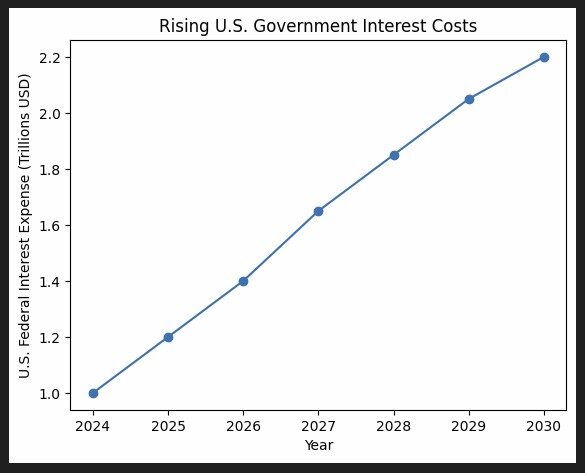
The projections above are just the “interest” side of the coin. Two massive demographic shifts will act as accelerators:
- Social Security Trust Fund Exhaustion (2033–2034): The “reserves” are currently just accounting entries in the form of Treasury bonds. When the fund runs dry in roughly 8–9 years, the government can no longer “borrow” from itself. It must either cut benefits by ~23% or borrow the difference from the open market, adding trillions more to the national debt.
- Medicare’s “Silver Tsunami”: As the last of the Baby Boomers hit their 80s in the 2030s, Medicare spending is projected to grow at roughly 7.5% per year. By 2035, health care and interest together will consume roughly 50 cents of every tax dollar collected.
When does it become a “Crisis”?
A “crisis” level event is most likely to occur in the 2032 area (give or take a couple years depending on how economic events actually transpire) if interest rates remain at current levels or fall from here. If rates hit 7%, this timeline moves up aggressively to the 2028-2029, as the government would find itself in a “debt spiral”—borrowing money just to pay the interest on previous borrowing.
This is the “perfect storm” year where:
- The Social Security Trust Fund hits zero.
- Due to borrowing to pay Social Security, interest payments on the debt surpass $1.8 trillion (under current rates).
- The Public Debt-to-GDP ratio 125%, a level historically associated with significantly slower economic growth.
- There are really two Debt-to-GDP ratios: Total and Public.
- Total Public Debt (124% of GDP as of today): This is the $37.6 trillion figure of national debt you hear in the news. It includes money the government owes to itself (like the Social Security Trust Fund – yes, those FICA withholdings you see coming out of your paycheck are not going into the Trust Fund like you were made to believe – the government comingles that money with the rest of our tax dollars to fund itself and give the Trust Fund IOU’s – not very reassuring is it).
- There are really two Debt-to-GDP ratios: Total and Public.
-
-
- Debt Held by the Public (115.5% of GDP): This amount is $30.3 trillion. This is what the government has actually borrowed from outside investors (banks, foreign nations, individuals, pensions, etc.).
-
The statement that a Public Debt-to-GDP of 125% is associated with “significantly slower economic growth” refers to a body of economic research (most famously by Reinhart and Rogoff) suggesting that when debt levels cross certain thresholds, a “debt overhang” begins to drag on the economy.
- The 90% Threshold: Historically, many economists argued that once Debt Held by the Public exceeds 90% of GDP, median growth rates fall by one percent or more. The U.S. passed this point years ago.
- The 120-125% Threshold: This is often cited as the “Danger Zone” for advanced economies. At this level, the amount of capital required to service the debt is so high that it “crowds out” private investment. Instead of money going into new businesses or infrastructure, it goes into buying Treasury bonds just to keep the government afloat.
If we take the starting point of Total Debt-to-GDP of 124% at the end of 2025, and apply the CBO’s projection of reaching $40 trillion by 2030, here is how that ratio evolves:
- 2025 (Actual): 122.6% ($37.6T Debt)
- 2027 (Projected): ~126-128% (This is where we likely cross the 125% Public mark)
- 2030 (Projected): ~132-135%
The Bottom Line
We are effectively “at the door” of that 125% threshold right now. When you factor in that the interest rates on this $37.6 trillion are currently being “reset” (as old 1% or 2% debt matures and is replaced by new 4% or 4.5% debt), the impact on the budget is much more immediate than the Debt-to-GDP ratio alone suggests.
Putting This Into Practice: A Framework for Action
Understanding the risks is only the first step. The real question is how to translate these insights into concrete portfolio decisions that protect accumulated wealth from a Sovereign Debt Crisis without abandoning growth opportunities.
Investing is always about balancing risk and reward.
Monitor the Right Indicators
Don’t just watch the debt clock or headline deficit numbers—they’re lagging indicators that tell you where we’ve been, not where we’re going. Instead, focus on forward-looking signals that reveal changing market dynamics:
- Treasury auction results, particularly bid-to-cover ratios and participation from indirect bidders (often foreign central banks)
- The spread between real and nominal yields, especially in TIPS markets
- Inflation expectations embedded in market prices and wage growth trends
- Dollar strength relative to major currencies
- Volatility in repo markets and changes in the yield curve shape
- Shifts in foreign holdings of U.S. debt and changes in fiscal policy credibility
Build Systematic Protections
Rather than trying to time the market, build hedges directly into the portfolio structure. This means making deliberate allocation choices that protect you regardless of exactly when or how quickly conditions deteriorate.
Increase your asset allocation to alternatives such as gold and commodity-linked investments if you anticipate issues ahead. These do not move up and down with stocks and bonds. At the same time, reduce exposure to long-dated Treasuries and growth stocks with no catalyst for sustained growth (think of Kodak once digital photography came to be) or ones carrying heavy debt loads. Consider rotating toward value equities with sustained cash flows and growing dividends, and sectors positioned to benefit from the changing environment—energy, industrials, and technology infrastructure, for example.
The practical application here is portfolio rebalancing with an eye specifically on real interest rates and inflation trends. You don’t need to make dramatic moves, but consistent small adjustments compound over time.
Prioritize Liquidity and Flexibility
During market stress, liquidity evaporates quickly. Assets that seemed perfectly tradable suddenly become difficult to sell at reasonable prices. This is especially true for private investments, complex structured products, and anything involving leverage.
If you manage your own investments:
- Maintain a meaningful cash buffer—typically 5-10% of a portfolio in high-quality cash equivalents or short-term instruments. This serves two purposes: it provides dry powder to take advantage of opportunities during market dislocations, and it ensures you won’t be forced to sell long-term holdings at the worst possible moment.
- Review your margin exposure and reduce leverage when uncertainty is high. Leverage amplifies both gains and losses, but during crises, it primarily amplifies your vulnerability to forced selling at exactly the wrong time.
Prepare for Increased Volatility
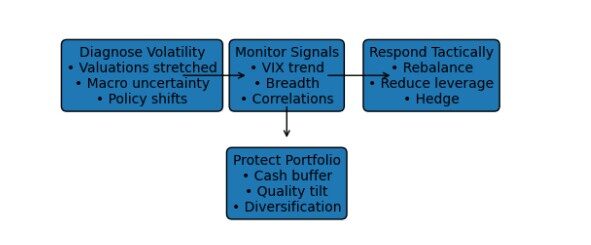
Perhaps the most important mindset shift is this: a debt crisis is primarily about market functioning and confidence, not technical default. This means you should expect sharp swings in yields, currency values, and equity prices during transition periods. Markets don’t move in straight lines, and periods of stress often include violent short-term rallies that can shake out even well-positioned investors.
Use portfolio stress testing to understand how holdings would perform under various adverse scenarios. Run simulations assuming 5-6% inflation, 10-year Treasury yields at 6%, or a 20% decline in the dollar’s value. The goal isn’t to predict exactly what will happen—it’s to ensure a portfolio can survive a range of challenging outcomes.
Adjust asset allocations not to maximize returns in a best-case scenario, but to survive and maintain optionality in difficult ones. The investors who do best during crises aren’t those who perfectly predicted every twist and turn—they’re the ones who stayed solvent and positioned to act when opportunities emerged.
Moving Forward
None of this requires panic or dramatic upheaval of your investment approach. Rather, it calls for thoughtful, systematic preparation for a changing environment. By understanding the specific mechanisms through which a debt crisis affects different asset classes, monitoring the right forward-looking indicators, and making deliberate portfolio adjustments, you can position portfolios not just to weather potential challenges but potentially to benefit from them.
The key is to act before stress becomes a crisis, maintain flexibility to adjust as conditions evolve, and never let short-term volatility force decisions that undermine long-term financial security.
Watching The Right Indicators
A huge part of my job in managing clients’ investments is Risk Management. You have to understand the trade-off between when it is time to be aggressive and when it is time to be conservative. You can have the best of intentions to protect your clients from some impending economic issue that you believe will cause the value of their investment to fall, only to see that issue never materialize. You may have raised cash to protect the gains you’ve experienced so that you could reinvest at lower prices, compounding the gains for their accounts. But instead of being the hero, you underperform the market, and clients are unhappy.
Fortunately, I have not done that in quite a while. But that is because I like to watch for specific early indicators that signal trouble in the market that could lead to a U.S. Sovereign Debt Crisis. As such, we were able to protect our clients quite well during the dot.com stock market crash and the 2008-2009 financial crisis.
Below, I am giving you a peek at my Crisis Monitor. It tracks various economic data points, as well as data on the operations of the US Treasury market. Watching economic data points alone is not enough, because there is no timing element to them that tells you when to take action. You have to see what is happening with investors’ actions to get an idea of when something might break.
I apologize for the size of the print within the grid. Normally, I view it in landscape mode, but this blog is in portrait mode.
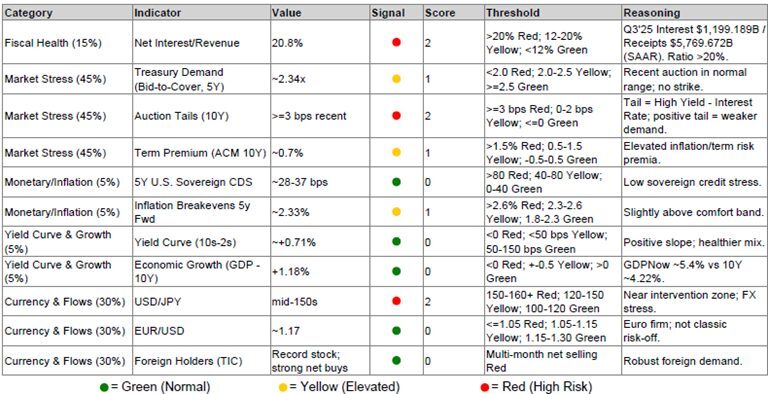
Scorecard: 5.38 / 10 – YELLOW (Elevated)
This grid provides a quantitative picture of where we are on the spectrum of risk that a financial crisis is on the horizon. I use it as an early warning sign to start looking at other macro factors (like the Japanese bond market crashing, gold skyrocketing, and our governments’ fiscal problems) to determine when to start seriously considering taking action.
Today, we sit at an elevated risk of a problem occurring. That does not warrant raising a significant amount of cash in client accounts at the present time.
Does that mean that there is no chance of a market correction this year? No, it does not mean that. Historically, we have three 8%-10% corrections every year and a 20% correction every 2.5 years on average.
I watch this to help me avoid the 40% – 50% crashes that occur every nine to eleven years. Right now, this monitor is telling me that we do not have to worry about one of those in the near future. I will be discussing this more in a future blog post – the draft is already written – where we will look at how stock market cycles and cycle theory impact investment management.
You may be wondering why there are no stock market factors in the Crisis Monitor. That is easy since the bond market is significantly bigger than the stock market, and because any major issue will first appear in the bond market and cross over into the stock market.
The AI Infrastructure Revolution: A New Dimension
As we consider how to position portfolios for a changing fiscal landscape, there’s an emerging factor that deserves special attention: the artificial intelligence revolution. This isn’t just another technology trend—it represents a fundamental shift in how economic value gets created and how productivity gains flow through the economy. Understanding this dynamic is increasingly important for investors navigating debt crisis scenarios.
How AI Infrastructure Influences Debt Dynamics
It is no secret that I believe the adoption of AI will bring monumental changes to how we live, work, and invest. I have written posts on the blog here, here, and here. As such, we need to examine how it might impact a potential Sovereign Debt Crisis.
AI infrastructure—the physical and digital systems that power artificial intelligence—enables several mechanisms that could meaningfully affect national debt trajectories and investment outcomes.
- Productivity gains and GDP growth. Large-scale AI deployment has the potential to drive substantial productivity improvements across nearly every sector of the economy. When productivity rises, GDP growth accelerates without necessarily requiring proportional increases in labor or capital inputs. This matters for debt sustainability because it improves the debt-to-GDP ratio by reducing the denominator—the economy grows faster than debt accumulates. Companies that successfully deploy AI can achieve higher revenues and profits with the same or fewer resources, potentially increasing tax revenues without raising rates.
- Infrastructure investment as an economic multiplier. The buildout of AI infrastructure—data centers, specialized chip manufacturing, power generation and grid upgrades, cooling systems, and fiber networks—represents hundreds of billions in capital investment. This creates immediate economic activity through construction, equipment manufacturing, and job creation. Unlike some forms of government spending, private-sector AI infrastructure investment doesn’t directly add to government debt while still providing economic stimulus effects.
- Deflationary pressure on goods and services. AI-driven automation and efficiency gains can reduce production costs across industries, from manufacturing to services. This creates disinflationary pressure that could help offset some of the inflationary forces we discussed earlier. If AI helps keep inflation in check, it reduces one of the key pressures that erode bond values and force yields higher. For investors, this means that sectors that leverage AI effectively might maintain pricing power and margins even during periods of general economic stress.
- New revenue streams and tax base expansion. The AI sector itself creates entirely new categories of economic activity—from AI-as-a-service platforms to specialized consulting, from novel entertainment and media to enhanced financial services. Each of these represents potential tax revenue that didn’t exist before, marginally improving fiscal positions without politically difficult tax increases or spending cuts.
I wrote a series of blog posts on AI, so I will not repeat that here, as this is already longer than I intended. You can find those posts on the blog here, here, and here.
Connecting AI Infrastructure to the Broader Debt Thesis
The relationship between AI infrastructure and debt crisis preparation isn’t immediately obvious, but it becomes clear when you consider portfolio construction during uncertain times.
If the debt crisis unfolds gradually with persistent inflation, AI infrastructure provides real asset exposure with pricing power—exactly what you need. If productivity gains from AI help accelerate GDP growth, it improves sovereign debt sustainability and supports risk assets generally—AI infrastructure holdings benefit while also making the debt crisis itself less severe. If rising yields pressure traditional growth stocks, the current cash generation and contracted revenues in mature AI infrastructure provide some insulation.
Perhaps most importantly, AI infrastructure represents one of the few sectors where massive capital investment is occurring regardless of fiscal conditions or interest rate levels. Companies and countries view AI capability as existentially important to competitiveness. This means demand for infrastructure continues even during periods when other sectors are retrenching—providing a growth vector that persists through cycles.
The key is viewing AI infrastructure not as a replacement for the defensive positioning we discussed earlier, but as a complement. It’s the growth component in a portfolio otherwise oriented toward resilience and capital preservation. A reasonable approach might allocate 5-15% of equity holdings specifically to AI infrastructure themes, scaled based on risk tolerance and investment timeline.
Summing It Up
None of this requires panic or dramatic upheaval of an investment approach. Rather, it calls for thoughtful, systematic preparation for a changing environment. By understanding the specific mechanisms through which a debt crisis affects different asset classes, monitoring the right forward-looking indicators, and making deliberate portfolio adjustments, you can position portfolios not just to weather potential challenges but potentially to benefit from them.
The AI infrastructure dimension adds another layer to this framework—representing both a potential mitigating factor for debt sustainability and a compelling investment opportunity that combines growth potential with real asset characteristics. As with all investment decisions, the goal is building a portfolio that can perform across a range of scenarios rather than betting everything on a single outcome.
The key is acting before stress becomes crisis, maintaining flexibility to adjust as conditions evolve, and never letting short-term volatility push you into decisions that undermine long-term financial security.
Conclusion: From Awareness to Action
The Path Forward: Navigating Uncertainty with Clarity
We’ve covered a lot of ground—from the historical patterns that shape debt crises to the specific market signals that reveal when trouble is brewing. The journey through post-war debt overhangs, inflationary shocks, disinflation periods, and funding market disruptions wasn’t meant to overwhelm you with data points. Rather, it was designed to build a framework for understanding what actually matters when evaluating debt sustainability and protecting the financial future.
The central insight is this: debt crises rarely announce themselves with a single dramatic headline. Instead, they emerge gradually through changing market dynamics—rising yields that persist rather than normalize, auction results that steadily deteriorate, foreign buyers who quietly reduce exposure, inflation expectations that drift higher despite central bank assurances, and funding markets that become less reliable under stress.
By the time the crisis is obvious to everyone, the most effective defensive positioning has already happened. The investors who navigate these transitions successfully are those who monitored the right signals, understood the underlying dynamics, and acted systematically before conditions deteriorated into a full-blown crisis.
What Makes This Time Different—And What Doesn’t
Every era brings its own unique characteristics. Today’s landscape includes features we haven’t seen before: the scale of post-pandemic stimulus, the rapid shift in monetary policy from extreme accommodation to aggressive tightening, the emergence of AI as a transformative economic force, the complexities of deglobalization and reshoring, and the unprecedented levels of peacetime debt across developed economies.
Yet beneath these surface differences, the fundamental dynamics remain remarkably consistent with past episodes. The relationship between growth, inflation, and interest rates still determines debt sustainability. Investor confidence in institutions and policy credibility still drives funding conditions. Market functioning still depends on adequate liquidity and orderly price discovery. Real rates relative to growth still determine whether debt compounds toward crisis or stabilizes over time.
Understanding both the novel elements and the timeless patterns gives you the perspective needed to separate signal from noise. New technologies like AI may genuinely improve productivity and growth trajectories in ways that ease fiscal pressures. Structural changes in global reserve management may gradually reduce foreign demand for Treasuries in ways that weren’t factors in previous generations. But the core question remains unchanged: Can the economy grow fast enough, and can institutions maintain enough credibility, to keep debt sustainable at prevailing interest rates?
Final Thoughts: Informed Vigilance, Not Constant Anxiety
Debt sustainability is not a problem that gets solved and forgotten—it’s an ongoing dynamic that requires informed vigilance. But vigilance doesn’t mean anxiety. It means staying attuned to changing conditions, understanding how those changes affect markets and portfolios, and maintaining the discipline to act systematically rather than emotionally.
The framework we’ve built—understanding the drivers of debt accumulation and resolution, recognizing historical patterns that recur across eras, monitoring market indicators that reveal evolving stress, and positioning portfolios for resilience while maintaining growth exposure—provides a foundation for navigating whatever fiscal challenges emerge in the years ahead.
Will the United States experience a debt crisis? The honest answer is: very likely, but it depends on the relationships discussed above and how they evolve. If productivity growth from AI and other innovations accelerates GDP expansion, if inflation remains moderate and anchored, if political institutions demonstrate enough credibility to maintain investor confidence, and if interest rates stay below nominal growth rates, then high debt levels can remain sustainable for years or even decades. But at some point, if our debt-to-GDP ratio doesn’t fall below 100% again, then a debt crisis is almost inevitable.
If those relationships discussed above deteriorate—if growth slows while rates rise, if inflation becomes entrenched and forces yields higher, if political dysfunction erodes credibility, if foreign buyers accelerate their exit, or if funding market mechanics break down under stress—then the transition from high-but-stable debt to crisis to high-but-unstable can happen faster than most expect.
You don’t need to predict which scenario unfolds. You need to watch for the signals that reveal which path we’re on, maintain a portfolio positioned for resilience, and stay disciplined enough to adjust systematically as conditions evolve. That’s not a guarantee against losses—no framework can provide that. But it’s the most effective approach available for protecting wealth while maintaining the flexibility to pursue investment opportunities.
The coming years will test many assumptions about debt sustainability, monetary policy, inflation dynamics, and market structure. By understanding the historical patterns, monitoring the right indicators, and maintaining disciplined positioning, you’ll be better equipped to navigate those tests successfully—not through perfect foresight, but through systematic preparation and adaptive execution.
That’s the edge available to informed, disciplined investors. And in an era of elevated debt, heightened uncertainty, and rapid change, that edge matters more than ever.