
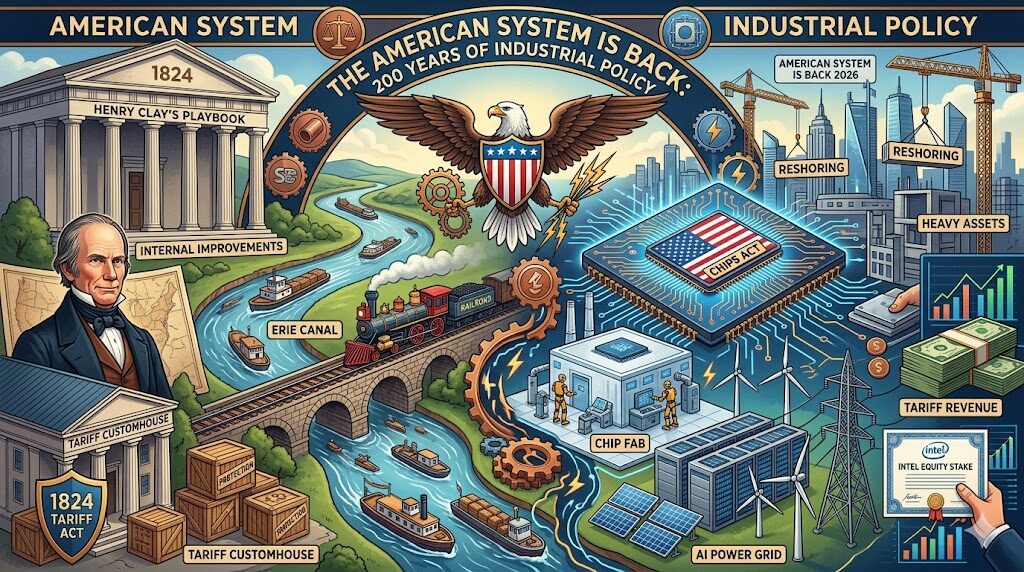
Washington just stopped pretending. For decades, both parties told us free markets would sort everything out. Now the government openly picks industries, takes equity stakes in public companies, and collects tariff revenue at a pace nobody has seen since the 1800s. You can love this shift or hate it. As an investment manager, I don’t get paid to do either. I get paid to understand it. And most of the commentary is missing the central fact: none of this is new. It has a name, a 200-year track record, and a founding father. The American System is back, and if you want to know where industrial policy takes markets from here, Henry Clay’s playbook is the place to start.
What Just Happened in Washington
Last week, Treasury Secretary Scott Bessent stood in front of a room full of free-market faithful at the Reagan National Economic Forum and delivered a speech titled “While America Slept.” His argument: the country spent decades trading industrial capacity for cheaper goods, and the bill came due. He told the audience that trade policy, industrial policy, and national security policy must fit together or fail separately. A Treasury Secretary said “industrial policy” out loud, on purpose, as a goal. That alone tells you the ground has moved.
The actions match the words. In August 2025, the government converted CHIPS Act grants into a 10% equity stake in Intel — 433.3 million shares, disclosed in an SEC filing, making the federal government one of the company’s largest shareholders. This month, officials confirmed they’re exploring similar stakes in the major AI firms, possibly through a “public wealth fund” seeded with donated equity. Meanwhile, tariff revenue hit $216.7 billion in fiscal 2025, up 146% from the prior year, and the Penn Wharton Budget Model projects around $323 billion for 2026.
And the economy keeps confounding the forecasters. The May jobs report showed 172,000 new jobs against a consensus estimate of 80,000, with March and April revised up by a combined 93,000. One good report doesn’t prove a policy works. But when every economist surveyed misses low, it suggests their models are calibrated for an economy that no longer exists.
So what system are we actually moving toward? Not socialism, despite what the louder corners of the internet say. Not laissez-faire either. We’re moving back toward the system this country ran on for its first 150 years. To understand it, you need to meet the man who built it.
Henry Clay: The Most Important Politician Who Never Became President
Henry Clay was born in Virginia in 1777, the seventh of nine children of a Baptist minister who died when Clay was four. Political opponents later mocked him as the “Mill Boy of the Slashes” — a poor kid from swampy Hanover County who hauled grain to the mill. Clay turned the insult into a brand. With barely three years of formal schooling, he apprenticed in a law office, earned his license at 20, and moved to frontier Kentucky, where ambitious lawyers were scarce and land disputes were not. By his late twenties he was the highest-paid attorney in the state.
Then came the most remarkable congressional career in American history. The House of Representatives elected him Speaker in 1811 — on his first day as a member, at age 34. Nobody has done that since, and nobody is likely to. Clay transformed the speakership from a refereeing job into the second most powerful office in the country, stacking committees and steering the agenda. As leader of the “War Hawks,” he pushed President Madison into the War of 1812, then sailed to Europe to negotiate the Treaty of Ghent that ended it. The war mattered enormously for what came next. The British blockade had strangled American trade and exposed how little the country could manufacture for itself. Clay came home convinced the United States needed an economy that could survive without anyone’s permission.
He ran for president three times — 1824, 1832, and 1844 — and lost all three, prompting his most famous line: “I would rather be right than be President.” The 1824 loss stung worst. With no electoral majority, the House decided the election, and Speaker Clay threw his support to John Quincy Adams, who promptly named him Secretary of State. Andrew Jackson’s supporters branded it the “corrupt bargain” and rode the grievance into the White House four years later. Politics, then as now, was a contact sport. When Clay died in 1852, he became the first American ever to lie in state in the Capitol rotunda.
We remember Clay as the “Great Compromiser” — architect of the Missouri Compromise of 1820, the compromise tariff that defused the Nullification Crisis in 1833, and the Compromise of 1850. Each deal pulled the country back from splitting apart. He was also, it must be said, a man of his contradictions: he spoke of liberty while enslaving people at Ashland, his Kentucky estate. History rarely hands us clean heroes.
But Clay’s deepest legacy isn’t compromise. It’s economics.
The Three Pillars of the Henry Clay American System
In a two-day speech before the House in March 1824, Clay laid out what he called the American System — deliberately named to contrast with the British system of free trade that dominated economic thinking then, much as it did from the 1980s until about five years ago. The system had three mutually reinforcing parts): protective tariffs to shelter American industry, a national bank to stabilize currency and credit, and federal spending on roads, canals, and harbors — what the era called “internal improvements.”
Clay didn’t invent the ideas. Alexander Hamilton did, in his 1791 Report on Manufactures, which argued that young industries needed temporary protection and subsidy until they could stand against established foreign competitors. Congress shelved most of Hamilton’s report. It took the War of 1812 — when Americans discovered they couldn’t manufacture the weapons, cloth, and iron they needed to fight — to make his case for him. A nation that couldn’t make things, it turned out, couldn’t defend itself. If that argument sounds familiar, it’s because Bessent made nearly the same one last week, warning that a country unable to manufacture, mine, ship, or refine what it needs gradually cedes its sovereignty to others.
Clay took Hamilton’s sketch and turned it into a governing program. The intellectual heart of his 1824 speech was the “home market” argument. Europe, he warned, would never reliably buy American farm surpluses; its own farmers and its colonial preferences came first. So American farmers needed American customers — factory workers and growing cities — and those customers would only exist if American industry survived foreign competition long enough to mature. Protection wasn’t a favor to factory owners, in Clay’s telling. It was how farmers got a market that couldn’t be embargoed, blockaded, or negotiated away. You’ll hear the same logic today whenever someone says supply chains running through a rival nation aren’t really supply chains. They’re leverage — someone else’s.
The legislative record followed. The Tariff of 1816 — the country’s first openly protective tariff, which Clay championed — sheltered the cotton and iron industries born during the war. The Tariff of 1824 extended protection to wool, iron, and hemp producers and squeaked through a divided Congress. The Second Bank of the United States, chartered in 1816 with Clay’s support, anchored the currency and disciplined the credit system. And a wave of canal and road building knit the regions together — most spectacularly the Erie Canal, finished in 1825, which cut freight costs between the Midwest and the Atlantic by roughly 90% and made New York the country’s commercial capital.
His vision was an integrated national economy: the Northeast manufacturing for the South and West, the South and West feeding and supplying the Northeast, with tariff revenue funding the infrastructure that connected them. Sound money, protected industry, and physical connectivity. That’s the whole playbook. Tariffs, directed investment, and a managed financial system — swap “canals” for “chip fabs and transmission lines” and you’ve described 2026.
What Happened When America Ran the Playbook
Clay never got the full system enacted in his lifetime, and the fights over it defined a generation of politics. President Andrew Jackson vetoed federal funding for the Maysville Road in 1830 — a turnpike that happened to run through Clay’s own Kentucky, which Jackson surely noticed. Two years later Jackson killed the Second Bank’s recharter, calling it a den of privilege, and the “Bank War” became the central issue of the 1832 election Clay lost. The aftermath is instructive for anyone who thinks monetary plumbing is boring. Without a national bank, credit creation migrated to loosely regulated state banks, fueled a land speculation frenzy, and ended in the Panic of 1837 — one of the deepest depressions of the century. The country then ran without any central monetary authority until the Federal Reserve arrived in 1913. We tested the no-managed-money alternative. It tested poorly.
The South fought the tariffs bitterly — and with reason, since the South paid the higher prices while the North collected the protection. South Carolina pushed the fight to the brink in 1832, declaring federal tariffs null within its borders. Clay, characteristically, engineered the compromise tariff of 1833 that walked everyone back. The Whig Party he then built around the American System carried his program forward, and one young Illinois Whig carried it further than Clay ever dreamed.
Abraham Lincoln called Clay “my beau ideal of a statesman” and campaigned on Clay’s economics his entire career — by his own account, he delivered his first political speech on the tariff. Once in office, Lincoln and his party passed the Morrill Tariff, the Pacific Railway Act that built the transcontinental railroad, the National Banking Acts that created a uniform currency, and the land-grant college system that gave us universities like the one up the street from our offices. Under that broad framework — high tariffs, national banking, massive infrastructure and education investment — the United States went from agricultural backwater to the largest industrial economy on earth by the 1890s. The era’s politicians never let anyone forget it, either. William McKinley, the “Napoleon of Protection,” put his own name on the 1890 tariff and won the presidency twice on the strength of the system Clay named.
Now, the honest caveat. Economists still argue about how much credit the tariffs deserve. Douglas Irwin’s research for the National Bureau of Economic Research suggests protection helped some industries while taxing everyone else, and that America’s growth owed at least as much to immigration, capital inflows, and abundant resources. Protection also bred its share of monopolies and political corruption — ask anyone who lived through the Gilded Age. The American System built American industry. It also built American lobbying. Both legacies are alive and well today.
After World War II, the United States deliberately abandoned the playbook. As the only industrial economy left standing, we had everything to gain from open markets, so we built the free-trade order and preached it for 80 years. That made sense in 1946. Whether it still made sense once our largest trading partner became our largest strategic rival is the question both parties have now answered, in rare agreement: no. The CHIPS Act passed under one administration; the equity stakes and tariff escalation came under another. Industrial policy is now the bipartisan default, whatever the campaign ads say.
The American System Industrial Policy and Your Portfolio
History lesson over. Now for the part you pay me for. If Washington is rerunning the American System, then the investment question isn’t whether you approve. It’s which assets the system favors. The 19th-century version favored railroads, iron, coal, and the banks that financed them. The 2026 version has its own beneficiaries, and they look a lot like the themes I’ve been writing about for the past two years.
Readers of my HALO post in March will recognize the overlap immediately. Goldman Sachs’ “Heavy Assets, Low Obsolescence” framework and Clay’s American System are, at bottom, the same observation: physical capacity is scarce, hard to replicate, and newly valuable. Industrial policy pours accelerant on that fire, because the government is now a paying customer, a co-investor, and a tariff wall, all at once.
Reshoring and the Capital Spending Wave
Manufacturing construction spending tells the story in one chart. The Census Bureau series tracked by the St. Louis Fed shows factory construction running near $200 billion a year — roughly triple the pre-2021 norm, even after cooling about 18% from its August 2024 peak. I include that decline on purpose. Anyone selling you a straight-line reshoring boom is selling, not analyzing. The buildout is real, large, and lumpy.
The companies that equip that buildout sit in the sweet spot. Think Caterpillar (CAT) and Deere (DE) on machinery, Eaton (ETN) on electrical equipment, and Nucor (NUE) on domestically produced steel behind a tariff wall. Several of these names already sit in our client portfolios under the Reshoring & Industrial Renaissance theme, and they were on Goldman’s HALO conviction list before Washington’s latest moves.
Copper, the Grid, and the New Internal Improvements
Clay’s internal improvements were canals and turnpikes. Ours are transmission lines, data centers, and the power generation to feed them. Every piece of that buildout consumes copper, which is why Freeport-McMoRan (FCX) and the broader metals and mining complex keep showing up in my writing. The International Energy Agency projects data center electricity demand will more than double by 2030. You cannot tariff your way to more electrons. You have to build, and building is a commodities story.
Semiconductors, With an Asterisk
Chips are the steel of this century, and the government has said so with money. But the Intel stake introduces something investors haven’t priced before: Uncle Sam as your largest co-shareholder. That cuts both ways. Government backing lowers the odds Intel is allowed to fail. It also means decisions may serve policy goals instead of shareholders, and policy experts have flagged the conflict of a government that regulates the same companies it owns. I own the theme. I size the individual names carefully.
What I’m Watching From Here
A few signposts will tell us whether the new American System compounds or stalls. First, follow the money, not the speeches: actual CHIPS disbursements, the structure of any AI equity deal, and whether tariff revenue keeps tracking the Penn Wharton projections. Second, watch manufacturing employment. Construction and equipment orders come first in any industrial buildout; payrolls arrive last. The monthly BLS report will tell us if the jobs follow the concrete. Third, watch the bond market’s verdict on all of it. Clay’s system ran on tariff revenue in a government that spent almost nothing. Ours runs alongside a national debt above $39 trillion, and the cost of financing industrial ambition matters as much as the ambition itself.
The Risks Nobody Should Skip
I’d be doing you a disservice if I ended on the bull case. The American System’s first run produced real costs alongside real growth, and the rerun will too.
Tariffs are taxes, and somebody pays them. The Richmond Fed’s analysis of tariff revenue is also a map of costs flowing through importers to businesses and households. The 19th-century South’s complaint — protection for one region, higher prices for another — has a modern echo in any company or family that buys imported goods. Inflation risk is the obvious portfolio translation, which is one more reason I keep real assets and gold in the mix.
Picked winners can become political orphans. Subsidized industries attract capital, then overbuild, then consolidate. Railroads did exactly that in the 1870s and 1880s, repeatedly and painfully. If chip fabs or AI data centers follow the same arc, the late money will get hurt. Valuation discipline isn’t optional just because the government is your co-investor. And policy itself can reverse. The American System was dismantled once before. Elections, court rulings, and trade deals can all redraw the map, which is why diversification across themes — not concentration in one — remains the house rule here.
The Bottom Line
Markets spent 40 years pricing assets under one set of rules: capital goes wherever it’s cheapest, governments stay out of the way, and asset-light is beautiful. Washington has now told us, in speeches and SEC filings and tariff schedules, that the rules have changed. The new rules are actually old rules — Hamilton drafted them, Clay named them, and Lincoln built a continental economy on them. Investors don’t need to cheer the change or mourn it. We need to recognize it, understand its history, and position accordingly. We’ve been doing exactly that.
If you’re not a current BCNA client and want to discuss how we’re positioning portfolios around these themes, reach out to Joel Wallace at [email protected] or call (217) 351-2870. We’d be glad to talk through what this means for your specific situation.
–Mark
Disclaimer: This post is for informational purposes only and should not be considered investment advice. The views expressed are my own analysis and opinions. Every investor’s situation is different, and you should conduct your own due diligence before investing in anything. You should consult with a qualified financial professional, like ourselves, before making any investment decisions. Past performance does not guarantee future results.