
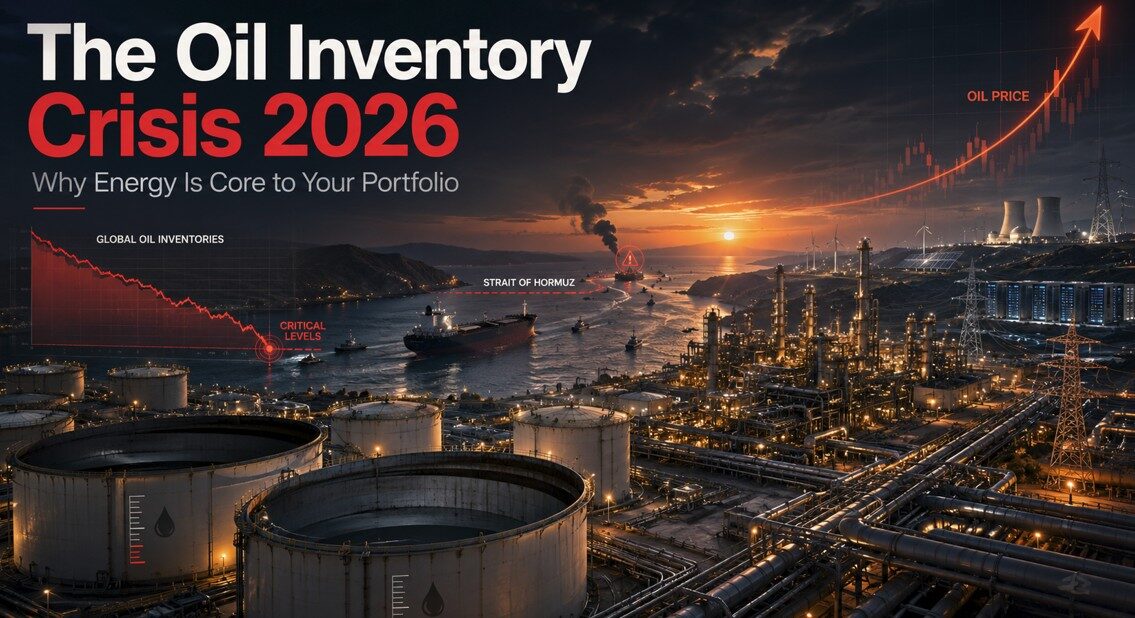
Oil inventories are collapsing toward a physical crisis point, according to JP Morgan, Goldman Sachs, ExxonMobil, and Chevron leading to the Oil inventory crisis 2026.
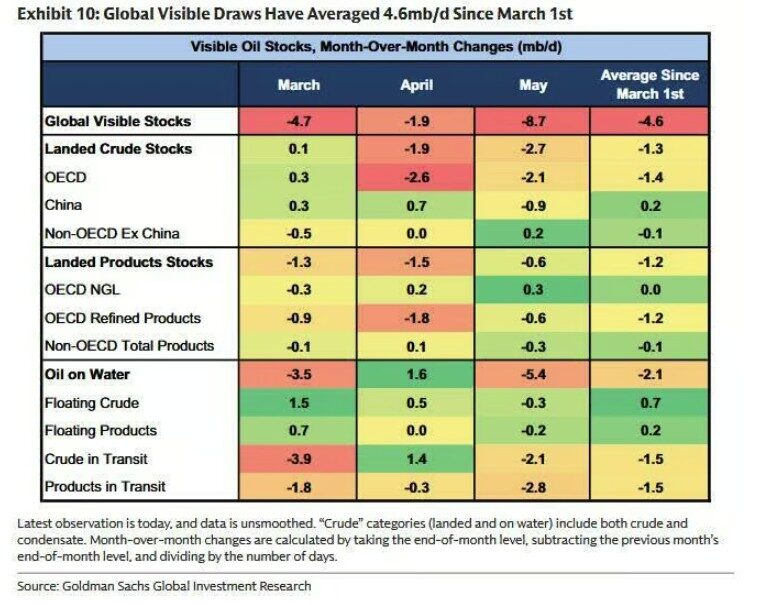
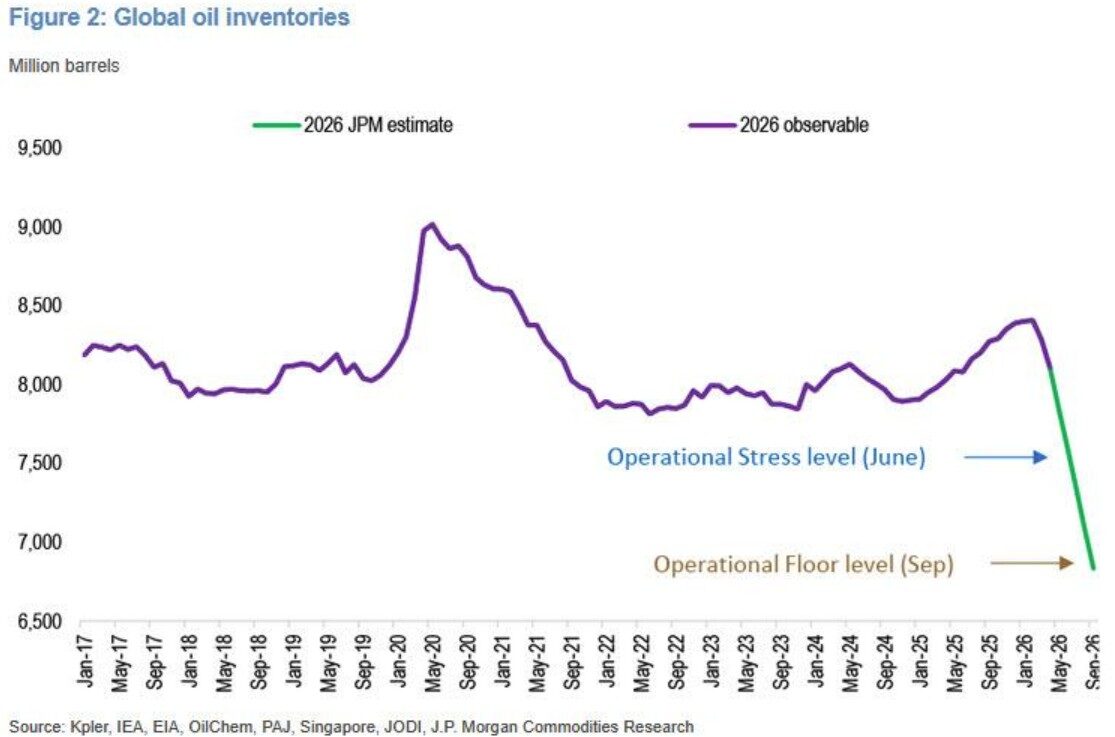
In May 2026, global inventory dropped 8.7 million barrels per day, a record decline that Goldman Sachs observed while the Strait of Hormuz remained largely blocked by the three-month Iran conflict. By late June—two to four weeks from now—OECD commercial inventories could hit operational stress levels (when inventory gets tight enough that refineries struggle to maintain throughput, markets start to strain, and prices rise above recent highs). By September, we hit the operational floor—the absolute minimum inventory required to keep the global oil system functioning—if the Strait stays closed.
Exxon doesn’t mince words about what happens next. SVP Neil Chapman told investors this week that crude oil prices will shoot up to $150-160 per barrel once inventories reach those really low levels. That’s not speculation. That’s modeling based on physical supply constraints, not market psychology, and supports the Oil inventory crisis 2026.
Here’s why this matters for your portfolio: we’re entering a period where energy inflation doesn’t spike and crash—it gets sticky. And sticky inflation is exactly what my 2026-2032 playbook predicts. That’s why we’re overweight energy in BCNA client portfolios relative to the S&P 500, not because we’re betting on $200 oil, but because we’re hedging the slugflation scenario that defines the next six years.
How Inventories Actually Constrain Price in a Crude Oil Supply Crisis
Most investors treat oil inventories like a boring data point. It’s not. Think of global crude stocks like the shock absorber on your car. They smooth out the bumps. When working stocks get low enough, even small supply disruptions blow through to prices immediately.
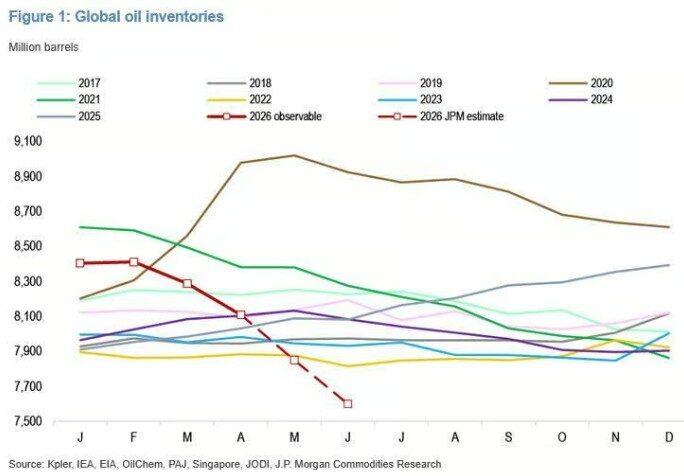
JPMorgan calculated that of the 8.4 billion barrels in global oil inventories at the start of 2026, only 0.8 billion barrels were realistically available without pushing the system into operational stress. That’s the working stock—the oil that actually circulates through the system.
The rest? It’s locked up. Refineries maintain minimum operating levels because they can’t turn on and off efficiently—they need baseline throughput to function. Tankers crossing oceans have product locked in transit for weeks. Storage facilities can’t extract oil below certain pressure levels, so the bottom of every tank is essentially trapped.
Strategic reserves aren’t tapped for normal market supply. Pipeline infrastructure requires minimum volumes flowing through to maintain pressure. Once you account for all that committed inventory, you’re left with less than a tenth of global stocks that can actually move into the market. The other 7.6 billion barrels that seem available on paper? They’re already spoken for.
So when the Strait of Hormuz closure removed roughly 10 million barrels daily from global supply, the market didn’t adjust prices upward right away. Instead, refiners and trading companies are burning through those 0.8 billion barrels of working stock. Every barrel drained from that buffer is one day closer to the operational floor in this Oil inventory crisis 2026.
The crisis isn’t just crude oil. Diesel—the lifeblood of global transportation and industry—is under even more pressure. Pakistan’s petroleum minister reported in late April that the country has only 20 days of commercial diesel reserves left. Vietnam and the Philippines face even grimmer supply situations. When you’re down to weeks of diesel fuel, you’re not negotiating prices anymore. You’re rationing supply. Trucks stop moving. Factories idle. Farmers can’t harvest. That’s not an inflation story. That’s a supply collapse playing out in real time.
The timeline is brutal. OECD commercial stocks could fall to operational stress levels by June—that’s when inventory gets low enough that refineries can’t maintain optimal throughput, tankers start bottlenecking, and the system begins to strain. By September, we hit the global operational floor, which is the absolute minimum inventory needed to keep the global oil system functioning. Below that level, supply chains break. We’re talking weeks, not months, as the strain, bottlenecks, and supply chain disruptions will grow during this time.
Chevron CEO Mike Wirth confirmed this at a Bernstein conference. He said the buffers and shock absorbers are being steadily drawn down, and the market’s ability to absorb this imbalance is drastically diminished. When those buffers vanish, price discovery stops being gradual. It becomes mechanical. A key feature of Oil inventory crisis 2026
The Paradox: Why Prices Haven’t Spiked Yet
This is where it gets interesting. Oil prices actually fell 10% last week despite the Hormuz closure and inventory drain. Why? Because markets are trained to price in “deals are coming.” Announce an Iran resolution is near often enough, and traders will sell futures even as barrels of oil disappear from global circulation.
That’s a rookie mistake. Chevron’s Wirth expects more upward pressure on prices as we get into June and certainly into July, because the physical reality of low inventories will eventually overwhelm the narrative of imminent peace deals.
Even the head of UAE’s Abu Dhabi National Oil Company (ADNOC) cautioned that full oil flows through the Strait were unlikely before 2027, and it would take at least four months to get back to 80% of pre-conflict flows. So even if the shooting stops tomorrow, the pipeline takes time to refill. Prices stay elevated through the refill cycle.
The wildcard is Chinese strategic reserves. With 1.4 billion barrels in China’s Strategic Petroleum Reserve, Beijing could delay the reckoning if it opens the floodgates. That’s a geopolitical variable, not a market one. And it’s not something we can control, but one we have to monitor in portfolio management.
Energy Inflation Gets Sticky, Not Spiky With The Strait of Hormuz Closure
Here’s where my macro thesis connects to portfolio construction. Most investors fear hyperinflation or a deflationary crash. Neither is coming, in my opinion. What’s coming is slugflation—inflation that stays elevated (3-4%) while real growth stays tepid (1-2%), creating a persistent squeeze on corporate margins and consumer purchasing power. An oil inventory crisis that pushes prices to $150-160 fits that slugflation narrative perfectly. It’s not a one-time shock that resolves in six months. It’s a supply-side constraint that persists for months, drives energy costs higher across the economy, and feeds into sticky input costs for manufacturing, transportation, and heating.
Exxon modeled that once crude hits really low inventory levels, demand destruction brings prices back into balance when prices become unaffordable. But that demand destruction—factories shutting down lines, consumers cutting back—is recessionary. It’s not a clean price reset. It’s a slowdown that coexists with elevated inflation.
That’s slugflation. And it’s exactly the environment where energy holdings outperform during the Oil inventory crisis 2026.
Three Layers of Energy Exposure: Why We’re Overweight as an Energy Inflation Hedge
Our overweight energy position isn’t a binary bet on oil prices. It’s a three-layer hedge:
Layer One: Traditional Oil & Gas (Upstream + Refining)
These are the cash-printing machines when crude is stuck between $90-150. Upstream operators—integrated oil companies and pure-play producers—generate massive free cash flow in this price band. Refiners benefit from the spread between crude and finished products. These businesses throw off cash to shareholders through buybacks and dividends. In a slugflation environment where growth stocks can struggle, cash-generative energy stocks provide ballast.
The math is simple. At $120 crude per barrel, a 150,000 barrel-per-day producer with $40 all-in costs generates roughly $12 million daily in gross margin. That compounds into the billions annually. In a low-growth economy, that cash return matters.
Layer Two: Midstream Energy Infrastructure (Pipelines + LNG)
This is where we get recurring revenue durability. Midstream companies—pipeline operators, LNG terminals, gathering networks—earn fees for moving oil and natural gas. They’re not exposed to commodity prices directly (although their stocks prices can move like they are. They’re exposed to throughput volume. As long as crude flows through the Strait and demand destruction stays modest (say, 5-6% of global supply), volumes hold.
The beauty of midstream is contractual. Most Western countries have released strategic petroleum reserves, which means governments are already acting to keep some demand in the market. Demand destruction will be gradual, not sudden. Midstream volumes won’t crater overnight. That means earnings stability when commodity names are volatile.
Energy infrastructure also carries royalty trusts and master limited partnerships that distribute cash to unitholders. In a slugflation environment where real bond yields after inflation are low, these 6% yields attract capital.
Layer Three: Energy Technology (Nuclear Energy Investment+ Electric Grid Improvements + Battery Power + Power Semiconductors)
This is the longest-dated hedge. AI data centers are power-hungry. Nuclear generates baseload electricity without carbon. Grid modernization requires semiconductors, controls, and battery storage to manage demand swings. Solar and battery technology becomes critical infrastructure as AI pushes power demand skyward.
We’re not overweight nuclear because we love green energy (which we do). We’re overweight nuclear because it’s going to be essential infrastructure in a world where AI training clusters eat 100+ megawatts of power. Power semiconductors, grid equipment, and energy storage all sit in the critical-infrastructure stack for the next decade.
This layer doesn’t move on $150 crude. It moves on the secular demand for power. But it hedges the risk that energy inflation crimps the rest of the portfolio. If traditional energy and infrastructure are generating cash, and energy-tech is essential capex, then energy as a whole becomes defensive.
Why This Belongs in Your Portfolio Right Now
The S&P 500 allocates roughly 3.4% of its index to the “Energy” sector. BCNA client portfolios vary by strategy, but holdings in the official Energy sector run 3.5%-10.7% across allocations, with Blue Chip Income Strategy (our income-focused strategy) at the highest end and the Aggressive Growth Strategy at the low end.
But here’s the critical nuance: S&P’s sector buckets miss the full energy picture. Uranium and nuclear positions show up in Materials. Power semiconductors, grid modernization equipment, and energy storage technology sit in Industrials or Information Technology. When you map the complete energy-related-themes positioning—traditional oil/gas plus infrastructure plus uranium, nuclear, and energy technology—across all strategies, the true exposure in our strategies runs substantially higher than the official “Energy” sector percentages suggest. Our Aggressive Growth Strategy may have a benchmark allocation against the S&P 500, but it has a higher allocation to things like Nuclear, Grid maintenance and improvement, Battery Power, and Power Semiconductors, the areas where real growth lies.
That’s why the three-layer thesis matters more than sector allocations. Layer One (traditional oil/gas and refining) lives in the Energy sector. Layer Two (midstream and infrastructure) straddles Energy and Industrials. Layer Three (uranium, nuclear, power semiconductors, grid equipment, battery technology) spreads across Materials, Industrials, and Information Technology. Together, they form a coherent energy-theme hedge that standard sector buckets can’t capture.
Why the variation across strategies? Blue Chip Income runs highest in the official Energy sector (10.7%) because dividend-paying oil/gas and midstream companies throw off substantial yields in a sticky-inflation regime. Investors who need current income benefit from energy’s combination of cash flow and capital preservation. Growth-focused strategies like Aggressive Growth run lower in the official Energy sector (3.5%) because they’re chasing earnings growth, not cash yield. Growth trumps income in those allocations.
But every strategy carries meaningful exposure to uranium, nuclear, and energy technology through holdings classified elsewhere. That’s the real story. The three-layer thesis—traditional energy plus infrastructure plus energy technology—captures the full positioning better than S&P’s sector buckets do. If you invest in Index Funds, you miss these opportunities in your portfolio.
In every case, the energy-theme being overweight versus the index reflects the same macro thesis: traditional energy provides the cash cushion, midstream provides the recurring revenue, and energy technology provides the secular growth. Together, they hedge the specific inflation regime we’re entering.
Exxon’s warning about $150-160 crude isn’t a surprise. It’s exactly the price level that validates our thesis. At $150 crude, energy stocks generate returns that feel healthy in a slugflation world. At $110 crude, they’re just okay.
Energy analysts see $200 as inevitable if the Strait stays closed. WoodMacenzie analysts said: “In our view, US$200/bbl is not outside the realms of possibility in 2026. As energy market expert Vanda Hari told Al Jazeera: “If the Strait remains closed for months to come, then $200 oil becomes a near inevitability.” That’s when demand destruction kicks in and we’re in recession.
The inventory crisis of 2026 is the mechanism that gets us to that $150 level and very well keeps us there for the next 12-24 months. That’s the tactical window. The structural case is the 2027-2032 playbook, where energy remains essential, and inflation stays elevated.
What Happens When We Hit the Operational Floor in this Crude Oil Supply Crisis
Exxon modeled this explicitly. Once inventories hit those really low levels, crude shoots to $150-160. Then demand destruction brings prices back into balance when oil becomes unaffordable. That’s Exxon’s model telling you the price spike doesn’t hold. Higher prices reduce demand, and prices settle back as part of the Oil inventory crisis 2026.
I don’t know exactly where that equilibrium lands. Maybe $130-150 as they forecast, maybe different. But Exxon’s point is clear: the spike happens first, then demand destruction forces a rebalancing. That’s not a market crash scenario in their analysis. It’s a volatility event followed by a new equilibrium where energy stocks generate returns in a higher-cost environment.
What we won’t likely see is a clean resolution. Even if the Iran conflict ends tomorrow, it will take months to refill pipelines and bring refinery capacity back online. Countries with little to no energy production will begin to hoard oil, building a strategic reserve. Countries that have emptied their strategic reserves will need to refill them. The supply constraint persists. Prices stay elevated. Energy cash flow stays robust.
That’s why we’re positioned the way we are. Not because we’re oil bulls. But because we’re hedging the specific inflation regime where sticky energy costs matter more than growth narratives.
Market Update
You’re probably noticing the Nasdaq is selling off while the Dow Jones keeps hitting new highs. That divergence is telling. I think investors are lightening up on high-growth tech names that have risen triple digits over the past year to raise cash for the SpaceX IPO coming June 12 plus the OpenAI (provider of ChatGPT) and Anthropic (provider of Claude) soon to follow . Clearing dry powder before a $75 billion mega-listing makes sense if you want in on the IPO. We don’t invest in IPOs for clients – historically, in the first six months to a year they pull back 30% or more and we will buy them then only if they successfully meet our very specific investment process’ standards.
But here’s what matters: this isn’t a warning sign. The S&P 500 earnings growth for the most recent quarter exceeded 20% across the broader market. Fundamentals are still strong. Valuations are reasonable relative to those growth rates. The pullback in Nasdaq names is temporary positioning ahead of a liquidity event, not the beginning of a sustained correction. The energy overweight thesis doesn’t change when growth names get shallow. If anything, it reinforces why energy exposure belongs in the portfolio—it doesn’t move on narrative swings about AI or IPO calendars. It moves on the physics of supply and demand.
In Closing
If you are not a client and you’d like to discuss how energy positioning works within your specific situation to deal with the Oil inventory crisis 2026, or whether your portfolio is overweight or underweight energy, let’s talk. The inventory crisis unfolds over the next few months. The structural positioning within investment portfolios needs to be in place now.
Reach out to Joel Wallace at (217) 351-2870 or [email protected] to discuss having us manage your investments with this macro framework in mind.
–Mark
Disclaimer: This post is for informational purposes only and should not be considered investment advice. The views expressed are my own analysis and opinions. Every investor’s situation is different, and you should conduct your own due diligence before investing in anything. You should consult with a qualified financial professional, like ourselves, before making any investment decisions. Past performance does not guarantee future results.