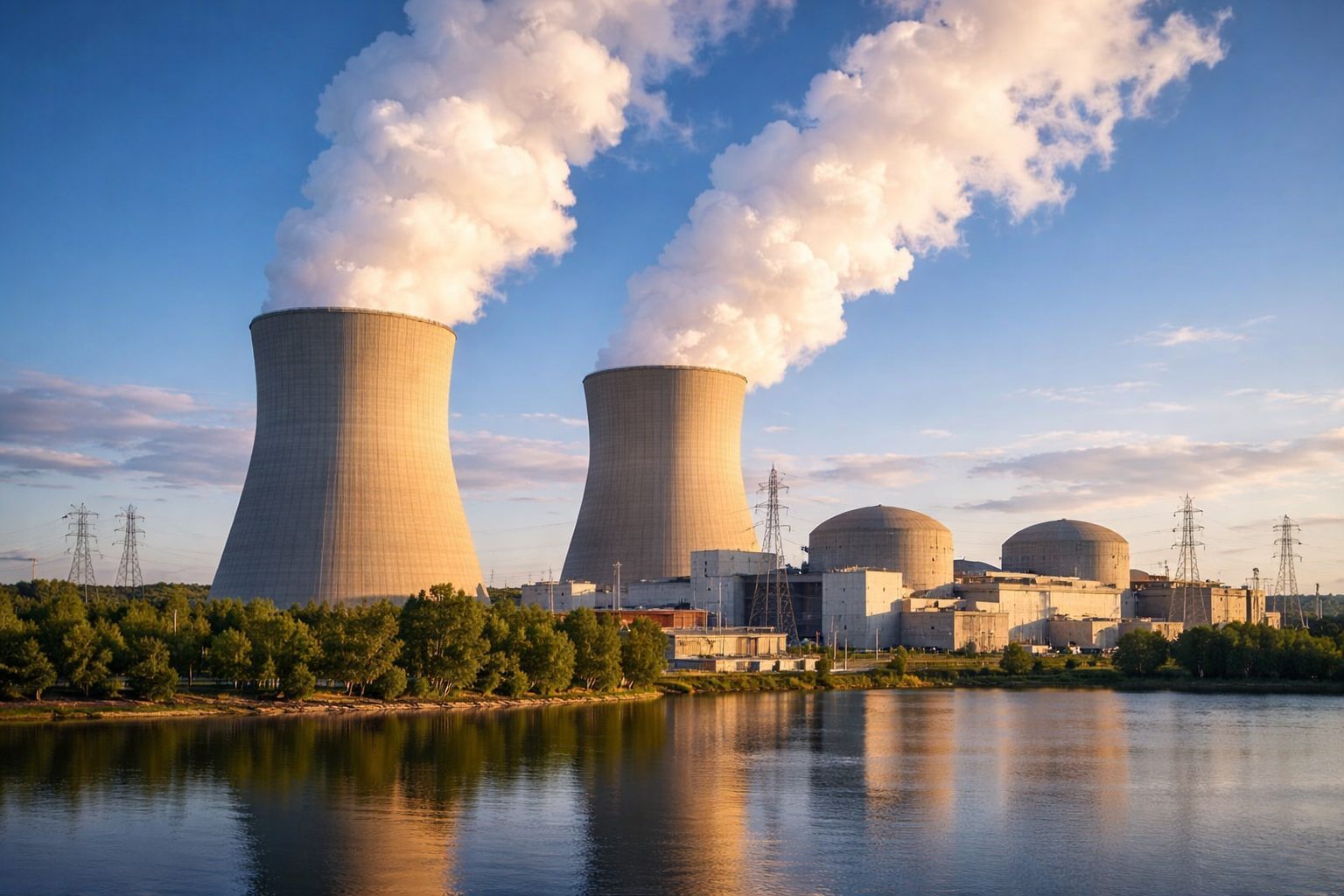
A look at where the fuel supply chain actually stands — and what it means for investors.
There’s a lot of excitement around nuclear energy right now. I get it – I’ve written about it on this blog. The story actually writes itself: clean baseload power, AI data centers demanding more electricity than the grid can handle, and a bipartisan push in Washington to revive domestic nuclear capacity. But here’s the thing — excitement and execution are two very different animals. And right now, the US has plenty of the former and a serious shortage of the latter.
Let me give you a concrete example of this. According to the Goldman Sachs Nuclear Nuggets monthly report, China is currently building 38 new nuclear reactors. India and Russia each have 6 under construction. The United States? Not even on the chart. China has started work on 10 new sites since the beginning of 2025 alone. Meanwhile, back in the US, we have splashy press releases and an $80 billion deal with Japan to fund as many as 10 large reactors — but not a single commercial-scale facility is actually under construction. Not one.
That’s a gap that matters. Not just for energy policy, but for anyone investing in the nuclear theme.
How We Got Here: The Decision That Came Back to Haunt Us
To understand why the US supply chain is in such rough shape today, it helps to go back to 2010. That year, the federal government’s Committee on Foreign Investment in the United States (CFIUS) — a multi-agency review body — approved the sale of Uranium One, a Canadian uranium mining company, to Rosatom, Russia’s state-owned nuclear energy corporation. At the time, Uranium One held licenses covering roughly 20% of US uranium production capacity. With the stroke of a pen, ownership of that domestic production infrastructure passed to the Russian government.
To be fair, US law prohibited the export of that uranium without a separate license, so the uranium itself wasn’t being handed over. But the mines, the equipment, and the production capacity were now under foreign state control.
The deal became more controversial as the years went on and US-Russia relations deteriorated. By 2022, when Russia invaded Ukraine and the US imposed sweeping sanctions, it was suddenly very awkward that American utilities were still buying enriched uranium from Rosatom. Congress didn’t pass the Prohibiting Russian Uranium Imports Act banning those purchases until 2024 — a full 14 years after the CFIUS approval. That’s how long it took to fully reckon with the consequences of that 2010 decision.
In short, decisions made over a decade ago created real structural holes in our domestic supply chain, and we are now in the uncomfortable position of trying to patch those holes quickly. Unfortunately for us, it doesn’t patch fast.
The Fuel Problem Nobody Is Talking About
Even if we started building nuclear power plant reactors tomorrow — which we aren’t — there’s a second problem sitting underneath the first one. We don’t have the fuel supply chain to run them.
Almost all of the uranium going into the current US nuclear power plants is imported. That’s right — we’re already dependent on foreign sources for the reactors we have running today. On top of that, domestic enrichment capacity can only supply about one-third of what US reactors need. So we’re already running a two-thirds deficit on that side of the equation.
Now layer in the next generation of reactors. Many advanced reactor designs require a different type of fuel altogether — high-assay low-enriched uranium, or HALEU. It’s more potent than conventional reactor fuel and harder to produce. Right now, the US has exactly one demonstration-scale production line for HALEU. One. It belongs to Centrus Energy — which, as I’ve written before, has been a stock we’ve held in client portfolios. Amir Vexler, Centrus’s CEO, put it plainly: “The core of the issue is insufficient capacity. We need a lot of everything.” That is not a reassuring quote from the CEO of the only company doing this work at scale in America.
Four Stages, Four Bottlenecks
The nuclear fuel supply chain has four distinct stages, and progress is happening at each one — just not nearly fast enough.
Stage 1: Mining
Several US uranium miners, including Ur-Energy, are planning to boost domestic output. More US mining is a good thing. But mining is the easy part of this chain. The harder work happens downstream.
Stage 2: Conversion
Before enrichment can happen, mined uranium oxide has to be converted into a gas — uranium hexafluoride. There is exactly one US company that does this: ). They just announced plans to increase capacity. That’s welcome news, but it also tells you something that there’s only a single company performing this function in the entire country.
Stage 3: Enrichment
This is where Centrus comes back into the picture. The company hired construction giant Fluor Corp. to build a multibillion-dollar enrichment facility in Ohio. In January, Centrus was one of three companies that each received $900 million from the Department of Energy to expand US enrichment capacity. That’s real money, and it’s a meaningful step forward. But enrichment plants don’t open overnight. We’re talking years.
Stage 4: Fuel Fabrication
The final stage in the chain is turning enriched uranium into the actual fuel assemblies that go into reactors. X-Energy Reactor — an advanced nuclear company backed by Amazon — just received US approval for a new fuel fabrication plant. Critically, this is the first such license granted in more than 50 years. That’s a milestone worth noting, even if it also illustrates just how long this sector has been dormant.
The Navy’s Fuel Problem — And the Ticking Clock Nobody Is Talking About
When most people think about US nuclear power, they picture commercial power plants. But the US Navy has quietly operated the most successful nuclear program in history — running nuclear-powered submarines and aircraft carriers since the USS Nautilus first put to sea in 1955. Today, over 40% of the Navy’s major combat vessels run on nuclear power. Zero accidents in 70 years of operation. It is, by any measure, a remarkable engineering achievement.
But the Navy’s reactors run on a very different fuel than commercial power plants. They use highly enriched uranium (HEU) — enriched to about 93% purity, which is weapons-grade material. That level of enrichment allows a very small reactor to generate enormous amounts of power for years without refueling, which is exactly what you need in a submarine running silent under the ocean for months at a time.
Here’s where it gets interesting from a supply chain standpoint. The US stopped producing HEU entirely in 1992 — the end of the Cold War meant there was no need to keep making weapons-grade uranium. So, for the past 30-plus years, the Navy has been fueling its fleet by drawing down a stockpile of HEU left over from dismantled Cold War nuclear warheads. When a warhead gets taken apart, that weapons-grade uranium gets shipped to the Y-12 National Security Complex in Oak Ridge, Tennessee, processed, and eventually fabricated into naval fuel by BWX Technologies (BWXT) at its facility in Erwin, Tennessee. The Navy has essentially been running on recycled bomb material for three decades.
That stockpile is finite. Current projections show it lasting the Navy only until around 2060. That sounds far away until you realize that the lead time to build a new HEU production facility — assuming the political will exists — is measured in decades, not years. The National Nuclear Security Administration (NNSA) is already raising the alarm that a new production facility will be needed well before 2060 if the Navy is to maintain continuous operations.
The AUKUS agreement — the 2021 pact under which the US and UK agreed to provide Australia with nuclear-powered submarines — has added a new wrinkle. Fueling Australian submarines means drawing down that Cold War HEU stockpile even faster. Some analysts estimate the eight submarines promised to Australia alone would require roughly four tons of HEU — enough, if not used in reactors, to build 160 nuclear weapons. That’s a lot of strategic material to commit before we’ve solved the production gap problem.
The alternative being studied is a transition to low-enriched uranium (LEU) fuel for naval reactors — the same class of fuel used in commercial power plants, and what France and China already use in their submarines. The trade-off is real: LEU-fueled reactors require either larger reactor cores or more frequent port visits for refueling, neither of which the Navy loves. But the alternative — restarting HEU production from scratch for the first time since 1992 — is an enormously expensive and politically complicated undertaking.
The investment angle here is direct. BWX Technologies (BWXT), a company we own in client portfolios, is the primary manufacturer of naval nuclear fuel and reactor components, a role it has held for over 70 years. It is the very definition of a Wide Moat business – one of those rare businesses where the barriers to entry aren’t just high — they’re effectively permanent. You can’t replicate 70 years of classified institutional knowledge, specialized facilities, and defense nuclear certifications. It is one of the few companies with security clearances, facilities, and institutional knowledge to do this work — which makes it a structural beneficiary of whatever solution the Navy ultimately pursues, whether that’s new HEU production, an LEU transition, or both. It’s not a flashy stock, but it’s a serious one.
While We Wait for Big Reactors: The SMR Workaround Right Here in Our Backyard
Here’s something that is just starting to get coverage in the mainstream media: while the US waits for large commercial reactors that are still years — maybe a decade — away, a different class of nuclear technology is already moving forward. Small modular reactors (SMRs) and their even smaller cousins, microreactors, are being built and tested right now. And one of the most notable projects in the country is happening 15 minutes from our office.
In April 2025, the University of Illinois Urbana-Champaign (UIUC) signed a formal agreement with NANO Nuclear Energy to build the first KRONOS micro modular reactor (MMR) on its campus. The KRONOS is a high-temperature, gas-cooled reactor — a design that runs significantly hotter than conventional reactors, which makes it useful not just for electricity but for industrial heat applications like hydrogen production and desalination. The U of I will own the site permanently and lead the regulatory process with the Nuclear Regulatory Commission (NRC); NANO Nuclear handles the design and construction.
This isn’t the U of I’s first rodeo with nuclear, either. The campus ran a TRIGA Mark II research reactor for 38 years — from 1960 to 1998 — before it was shut down. This new project is a return to that legacy, but with technology that didn’t exist back then. The reactor will be underground, which improves both safety margins and security. Early modeling by the DOE’s microgrid program found that integrating an SMR into the UIUC campus microgrid could cut carbon emissions by 60 to 85%, depending on the configuration.
The broader point here is that SMRs represent a parallel track to the large reactor build-out — one that moves faster, costs less per unit, and can be deployed in places a 1,000-megawatt plant never could.
Think of university campuses, military bases, industrial parks, and remote communities. They won’t replace utility-scale nuclear, but they don’t need to. They fill a completely different gap. For context, the Clinton Power Station — the conventional reactor just 45 minutes south of us — produces over 1,000 megawatts. The UIUC microreactor will produce about 15 megawatts. Very different tools for very different jobs.
From an investor standpoint, NANO Nuclear Energy trades publicly under the ticker NNE on Nasdaq. It’s a small-cap, early-stage company — meaning higher risk, but also a direct way to own the technology being deployed in our own community. We currently own a competitor of NNE in client portfolios, but NNE is on my watch list. As always, position sizing matters for stocks like this.
What This Means for Investors
I believe the nuclear story is real. Long term, I believe nuclear power is a critical piece of the US energy future, particularly as AI infrastructure drives electricity demand in ways the grid wasn’t designed to handle. But investors who are buying into pure reactor-build plays are betting on a timeline that is genuinely uncertain. New large-scale commercial reactors in the US are probably still a decade away from coming online at any meaningful scale.
The more interesting near-term trade, in my view, is the supply chain itself. The companies sitting at supply chain bottlenecks are in structurally advantaged positions regardless of which reactor timeline plays out — and several of them are publicly traded right now.
Centrus Energy (LEU), as noted earlier, is the most direct HALEU play. It’s the only US company with an operating HALEU production line, and it was one of three companies to receive $900 million from the DOE in January 2025 to expand enrichment capacity.
Cameco (CCJ), another company we are accumulating as price movement gives us a chance, is the largest publicly traded uranium producer in the world and has evolved well beyond mining — it owns 49% of Westinghouse Electric, which sits at the center of the US government’s $80 billion reactor build commitment announced in October 2025, and holds a stake in Global Laser Enrichment, a joint venture developing next-generation laser-based enrichment technology. If you want broad exposure to the entire nuclear fuel cycle in a single stock, CCJ is probably the most complete option.
Uranium Energy Corp (UEC), another company on my watch list, is building something more focused — a vertically integrated US supply chain from uranium mining in Texas and Wyoming all the way through a new conversion facility it’s developing with Fluor Corp., which would make it the only American company capable of handling that entire process on US soil.
For investors willing to look outside US exchanges, Silex Systems (SILXY), another watch list company, trades as an American depositary receipt and owns 51% of Global Laser Enrichment — the joint venture that recently hit a major commercial milestone on its laser enrichment technology at its Wilmington, North Carolina facility and is pursuing a commercial plant license in Paducah, Kentucky. Laser enrichment, if it scales, would be significantly cheaper and more energy-efficient than the centrifuge technology that dominates the market today. Silex is early-stage and loss-making, so it carries more risk than the others (hence just a watch list company that I track) — but the technology validation it received in 2025 was a meaningful step forward.
The nuclear theme is real. The hype is also real. As usual, the job of a serious investor is to separate the two. That is one of our jobs as a portfolio manager.
If you’re not a current client and are interested in discussing how nuclear energy and other thematic investments might fit into your portfolio, reach out to Joel Wallace at (217) 351-2870 or [email protected].
–Mark
Disclaimer: This post is for informational purposes only and should not be considered investment advice. The views expressed are my own analysis and opinions. Every investor’s situation is different, and you should conduct your own due diligence before investing in anything. You should consult with a qualified financial professional, like ourselves, before making any investment decisions. Past performance does not guarantee future results. Credit to an X post by ZeroHedge for the idea of this post.