
Wall Street put a name on it. We had a portfolio built for it.
Last year, I laid out an investment framework for the decade ahead that centered on eight themes. Real assets. Energy infrastructure. Defense. Nuclear power. Reshoring. And AI. AI was the hot trade at the time. The hot trade was anything with “AI” in the name, and the hotter it ran, the more I believed it would be a macro event larger than just semiconductors and software. So I kept writing about the physical world — the stuff you can’t replicate with a language model or a software update — and I kept getting questions about why I was so focused on “old economy” names when tech was flying (we had plenty of tech, too, just less than the S&P 500 benchmark allocation – but it was balanced by real assets, metals, gold, energy, infrastructure, and wide moat companies).
Goldman Sachs answered that question in February 2026. They called it the AI Halo trade. HALO stands for Heavy Assets, Low Obsolescence. I’ve been calling it our investment strategy.
That strategy soundly outperformed the S&P 500 as you can see in the graphic below that shows the past decade plus of performance (01/01/2015 through 02/28/2026) for our Blue Chip Growth Model Portfolio:
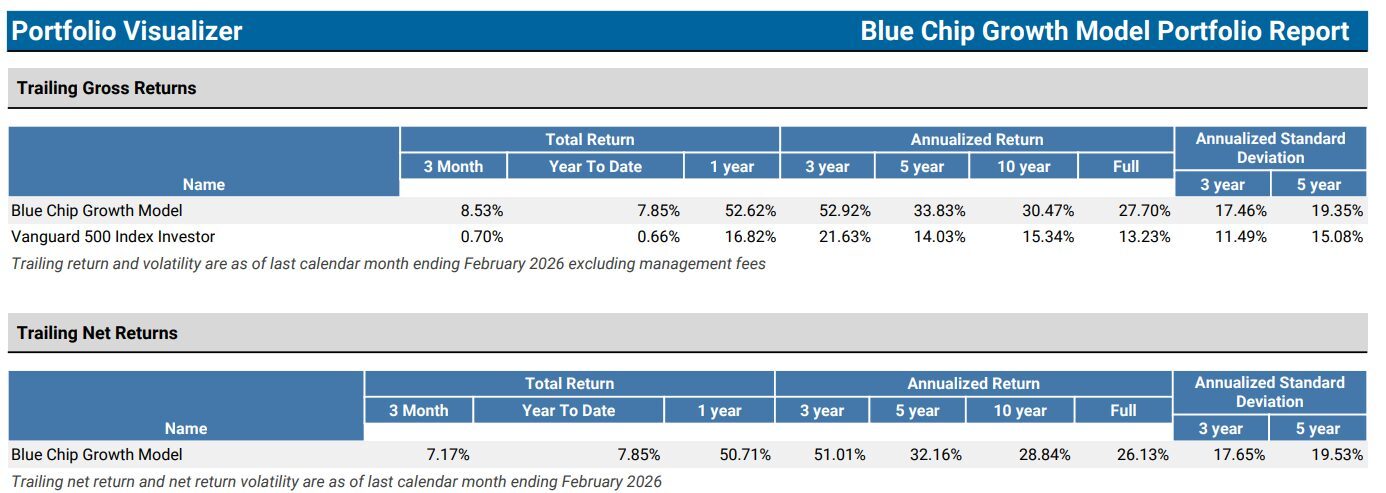
Performance shown reflects the Blue Chip Growth Model Portfolio and is presented for illustrative purposes only. Actual client portfolios following this strategy will be similar but will differ from the model due to factors such as security-level valuation considerations, the timing of trades, client-specific cash flows and liquidity needs, tax and capital-gain constraints, and other individualized circumstances. As a result, client account performance will vary from that of the model portfolio, even when benchmarked to the same strategy.
What Goldman Actually Said About the AI Halo
On February 24, 2026, Goldman Sachs strategists Guillaume Jaisson and Peter Oppenheimer published a report titled “The HALO Effect: Heavy Assets, Low Obsolescence in the AI Era.” The core argument for the AI Halo is straightforward: AI is creating a dual shock to markets. The first shock is that it’s gutting the competitive moats of asset-light software businesses — the Software-as-a-Service (SaaS) model that dominated the last decade. The second shock is that the physical infrastructure required to run AI — power grids, data centers, pipelines, chip fabrication plants — is so massive that the companies once celebrated for their capital-light elegance are now the largest capital spenders in history.
Goldman’s framing: the recent selloff in software and IT services isn’t about bad earnings. It’s a repricing of terminal value — the market asking a hard question about whether these businesses can sustain their historically fat margins when AI can do in minutes what used to take a team of developers weeks. Goldman called it “scarcity repricing.” Physical assets that are costly to build, slow to replace, and protected by regulatory complexity are getting revalued upward. Code is getting revalued downward. This is the AI Halo.
The Numbers Don’t Lie
Since January 2025, Goldman’s basket of heavy-asset stocks has outperformed their light-asset basket by 35%. That’s not a rounding error. And it lines up with what we’ve been watching in real-time across the themes I’ve been writing about:
The VanEck Gold Miners ETF (GDX) is up 156% over the past year. The SPDR S&P Metals & Mining ETF (XME) gained 92%. The VanEck Uranium and Nuclear Energy ETF (NLR) climbed 67%. Meanwhile, the iShares Expanded Tech-Software Sector ETF (IGV) — which holds the asset-light software darlings — fell 25%. The First Trust Dow Jones Internet Index Fund (FDN) dropped 10%.
On the earnings side, consensus forecasts now show faster earnings-per-share (EPS) growth and improving return on equity (ROE) for capital-intensive companies — while the same metrics are being revised down for capital-light ones. Goldman projects the compound annual growth rate of EPS for heavy-asset portfolios will reach 14% over the next few years. The light-asset group? Trending in the wrong direction.
The AI Halo Is Exactly What I’ve Been Writing About
I don’t say this to brag. I say it because pattern recognition is one of the most useful things I can offer clients, and the HALO thesis tracks directly onto what I’ve been building toward across multiple posts over the past year and a half.
In my 2026–2035 Investment Framework, I mapped eight themes for the decade ahead. Six of the eight — AI Infrastructure, Nuclear & Clean Energy, Defense & National Security, Reshoring & Industrial Renaissance, Real Assets & Inflation Defense, and Healthcare Innovation — are either classic HALO sectors or directly benefit from the same macro tailwinds Goldman is now citing. I talked about geopolitical fragmentation, the return of fiscal spending, and the structural need for physical production capacity. Goldman’s strategists used almost identical language in their February report.
In my Nuclear Energy post, I walked through the entire commercial nuclear fuel supply chain — enrichment bottlenecks, the Navy’s High-Enriched Uranium (HEU) stockpile timeline, Small Modular Reactors (SMRs), and why the supply chain matters more near-term than the reactor build-out timeline. Nuclear is about as HALO as it gets: enormous physical infrastructure, decades-long asset lives, virtually zero risk of being disrupted by a software update.
In my Black Swan post, I stress-tested portfolios against two tail scenarios — a China/Taiwan conflict and a U.S. sovereign debt crisis. In both cases, the assets that held up best were physical ones: gold, energy, defense names, hard infrastructure. Not coincidentally, those are the same assets Goldman is now flagging as HALO holdings.
And in my Photonics post, I made the case that the next phase of the AI build-out isn’t about more GPUs — it’s about the physical infrastructure to move data at scale. Fiber optics, power delivery, co-packaged optics (CPO). Heavy assets embedded deep in the AI supply chain, with long replacement cycles and high barriers to entry. Wall Street is now tripping over itself to own them.
The Irony at the Heart of the AI Halo Trade
Here’s the part that should make every tech investor stop and think. The companies most responsible for driving demand for HALO assets are the same companies that used to be celebrated for not needing them.
The five major U.S. hyperscalers — Microsoft, Alphabet, Amazon, Meta, and Apple — have spent roughly $1.5 trillion in capital expenditures between 2023 and 2026, building out the AI infrastructure boom. For context: that’s more than double what they invested in their entire history before ChatGPT launched in late 2022. In 2026 alone, their combined capex is on track to exceed $650 billion. Now, the markets are waiting to see if those investments positively impact the bottom line or if the debt acquired to fund them was wasted capital.
The irony is that AI hasn’t made the world lighter. It’s made it heavier. Every data center needs power. Every power grid needs upgrades. Every chip fab needs industrial-grade facilities, specialty gases, and precision equipment that takes years to build. Goldman put it plainly: AI is transforming the most iconic “asset-light” winners into the largest capital spenders in history. When that happens, the market’s old story about why asset-light businesses deserve premium valuations starts to crack – until proven otherwise.
As Josh Brown of Ritholtz Wealth Management — who originally coined the HALO acronym in early February 2026 — put it: “You can’t hallucinate a power grid.”
What AI Halo Actually Looks Like in a Portfolio
Goldman’s framework defines AI Halo companies by two traits: they rely on substantial physical capital with high barriers to replication, and they own assets whose economic relevance persists across technological cycles. That’s a fancy way of saying: you can’t code your way around a transmission grid, a pipeline, a uranium enrichment facility, or a 60-year-old aerospace supply chain.
The sectors Goldman and Morgan Stanley are highlighting include utilities, basic materials, energy, industrials, transport infrastructure, and consumer staples with dominant physical footprints. On Goldman’s specific conviction list: GE Aerospace (GE) — with a $190 billion order backlog — sits alongside Caterpillar (CAT), Prologis (PLD), Exxon Mobil (XOM), NextEra Energy (NEE), John Deere (DE), McDonald’s (MCD), Walmart (WMT), and Newmont (NEM). Many of these appear in the portfolios I’ve been building and repositioning for BCNA clients over the past year.
Value Matters
One note of caution I’ll add: valuation still matters. The HALO rotation is real, but that doesn’t mean you buy any asset-heavy company at any price. HALO names currently trade around 12x forward earnings vs. roughly 25x for high-growth software — that spread is attractive, but it’s not infinite. The rotation could intensify through the rest of 2026, or it could pause if the macro picture shifts. Position sizing and diversification still apply.
The Bottom Line
Goldman Sachs has a lot of smart people. When they put their name on a trade thesis, the institutional world pays attention, and money flows. That’s useful for the positions we’ve already been building. But the AI Halo trade didn’t originate on February 24, 2026 — it originated in the macro and structural logic that I’ve been laying out for clients for well over a year.
The world needs more power. It needs more physical infrastructure. It needs defense capacity, energy security, and supply chains that don’t run through a single adversarial nation. None of that gets solved by software. It gets solved by capital, engineering, and time — exactly the things HALO companies have been quietly accumulating while the market was busy chasing the next AI software story.
I’ll take being a year early over being six months late. The market is catching up.
______________________________
If you’re not a current BCNA client and want to discuss how we’re positioning portfolios around these themes, reach out to Joel Wallace at [email protected] or call (217) 351-2870. We’d be glad to talk through what this means for your specific situation.
–Mark
Disclaimer: This post is for informational purposes only and should not be considered investment advice. The views expressed are my own analysis and opinions. Every investor’s situation is different, and you should conduct your own due diligence before investing in anything. You should consult with a qualified financial professional, like ourselves, before making any investment decisions. Past performance does not guarantee future results.