

When the Trade Comes Before the Tweet: What $2.1 billion in perfectly timed oil bets tells investors about a new kind of market
An X post crossed my feed today that I couldn’t shake. It was written as a monologue from a surveillance analyst at a commodities exchange, Peter Girnus, describing the flags he keeps filing on suspicious oil trades and watching them go exactly nowhere. I liked it because the author did the hard thing: he took a story that’s been splintered across a dozen headlines and gave it a shape. The story of how a prediction market functions as an insider-trading marketplace, told in the voice of someone who sees the whole picture. At the end of this blog post, I’ll print the post in its entirety.
Then I went and checked his numbers. They held up. Every trade he referenced is in the public record, reported by Reuters, CNN, The Hill, and NPR. So let’s talk about what this means for investors, because the prediction markets asymmetric information venue question is bigger than oil futures and bigger than one administration. It’s about a whole new class of market that now sits next to the ones we’ve always watched.
The Pattern That Prompted a White House Memo
Here’s the timeline, stripped to the facts. On March 9th, 2026, roughly 47 minutes before a CBS reporter relayed presidential comments about the Iran war, someone bet on oil falling. Oil dropped 25%.
On March 23rd, 5,100 Brent and WTI contracts sold between 10:49 and 10:50 GMT. Fourteen minutes later the President posted on Truth Social about a pause on strikes. Over 13,000 contracts traded in the 60 seconds after the post. Oil dropped 11%.
On April 7th, a $950 million short position in oil futures went on at 19:45 GMT. Three hours later, a two-week ceasefire was announced.
On April 17th, $760 million in bearish bets, placed 20 minutes before Iran confirmed the Strait of Hormuz would reopen.
And on April 21st, 4,260 Brent contracts — about $430 million — sold 15 minutes before the ceasefire extension announcement. Brent went from $100.91 to $96.83.
Five Trades to Remember
Five trades. More than $2.1 billion in directional oil bets in a single month. Every one of them was on the right side of the next presidential announcement. Each one was placed in a window small enough to time with a stopwatch. And the windows are compressing in each successive trade: 47 minutes, 14 minutes, 20 minutes, 15 minutes.
On March 24th — the day after the March 23rd trade — the White House Management Office sent an email to staff reminding them it’s a criminal offense to use nonpublic information to place bets on prediction market contracts. The memo named Kalshi and Polymarket specifically. A White House spokesman told CNN that any implication that administration officials are engaged in insider trading is “baseless and irresponsible reporting.” Both things can be true at once. The trades are public. The memo is real. No names attached to the trades have surfaced.
I’m not here to tell you who did it. I don’t know. Nobody in the press has been able to tie a specific person to a specific trade. I wrote about the White House because that was in the X post, but there are plenty of other stories about members of Congress, their staff, and non-political government employees also using insider-information to trade in the prediction markets. What I can tell you is that the venue where this kind of insider-information trade is now possible is the piece most investors haven’t yet reckoned with.
Meet the New Market
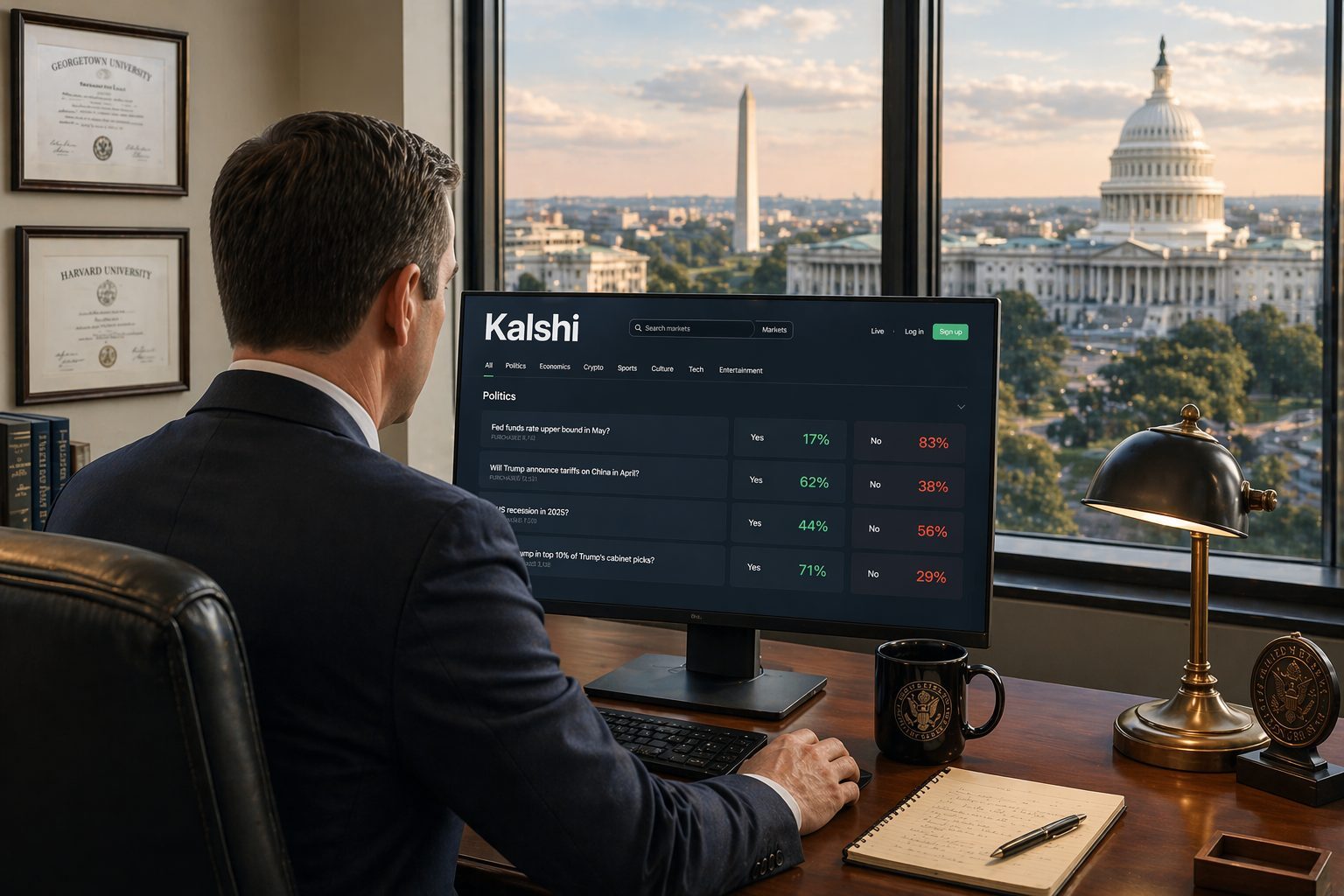
Prediction markets — platforms like Kalshi and Polymarket where you can buy “yes” or “no” contracts on whether a specific event will happen — were a curiosity two years ago. They’re not a curiosity anymore: prediction markets are an insider trading marketplace.
According to data compiled by MarketScreener from Dune Analytics, January 2026 set a single-month notional volume record of $26.75 billion across prediction market platforms. March came in at $25.7 billion — nearly 13 times the $2 billion traded in March 2025. Kalshi is now valued around $22 billion and Polymarket is raising at roughly $15 billion. Robinhood says event contracts are now its fastest-growing business line.
This is not a fringe product. It’s a $25-billion-a-month parallel market where people are betting on elections, interest rates, geopolitical events, sports, and everything in between. And unlike equity or futures markets — where the SEC and CFTC have had decades to build surveillance — the rules here are still being written in real time.
Where Are The Regulators
Kalshi is federally regulated by the CFTC and requires users to identify themselves, which is why its U.S.-facing product doesn’t list war contracts. Polymarket’s offshore site does list them, runs on crypto, and lets users stay anonymous behind a wallet address. That’s how six newly created Polymarket accounts collected roughly $1.2 million by betting on the February 28th U.S. strike on Iran — five of the six never placed another bet afterward. That’s also how an account called “Magamyman” made $553,000 on bets tied to the death of Iran’s supreme leader in the same operation.
One trader identified by blockchain analytics firm Bubblemaps, reported by CNN, won 93% of their five-figure wagers on Iran-related events dating back to 2024 — including bets placed hours before military operations that hadn’t been announced. Ninety-three percent. I’ll let you think about that.
Why This Is Not a Partisan Story
I want to be clear about something. I have clients across the political spectrum, and I care about getting this right and I don’t care about taking sides. This is not a story about one administration. It’s a story about a regulatory gap that predates this White House and will outlast it. Its about prediction markets becoming an insider-trading marketplace for people in our government.
Consider what else surfaced this month. On April 22nd, Kalshi suspended and fined three congressional candidates — a Democrat from Minnesota, a Republican from Texas, and a Virginia Senate candidate running as an independent — for betting on their own races. The fines ranged from $539 to $6,229. The suspensions run five years. As CNBC reported, this followed February suspensions of a visual effects editor for MrBeast’s “Beast Games” and a California gubernatorial candidate who publicly told supporters he’d bet on himself to win.
Congressional Action
Meanwhile, the legislative response is genuinely bipartisan. Senator Chris Murphy (D-Conn.) and Representative Greg Casar (D-Texas) have introduced legislation to ban government officials from profiting on prediction markets tied to war or government actions. Representative Ritchie Torres (D-N.Y.) has proposed the Public Integrity in Financial Prediction Markets Act, which would bar federal elected officials, political appointees, and executive branch employees from betting on policy outcomes. Senator Jeff Merkley (D-Ore.) wants to go further and ban all prediction market activity by Congress, the President, and the Vice President. On the Republican side, Representative Blake Moore (R-Utah) has his own bill targeting war and election contracts specifically, and Senator John Curtis (R-Utah) has co-sponsored restrictions with Democratic colleagues.
There’s also the disclosure hole. The House, Senate, and White House financial disclosure forms don’t even mention event contracts or prediction markets. Blake Chisam, a former chief counsel for the House Ethics Committee, called it a “blind spot” — the rules were written for blue-chip stocks and mutual funds, not yes-or-no bets. Members of Congress have to report trading gains, but they may not have to disclose what they actually bet on. That’s true no matter which party holds the gavel.
And the enforcement track record on the existing law isn’t encouraging. The STOCK Act — the 2012 law that was supposed to stop Congressional insider trading — has produced zero criminal prosecutions of a member of Congress in 14 years. The 2020 pandemic trades triggered a DOJ probe that ended with no charges. The typical penalty for a late disclosure under the STOCK Act is a $200 fine. That’s not deterrence. That’s a rounding error.
What This Means for Investors
I’ve been thinking about the practical takeaways. Here’s where I’ve landed.
Prediction markets are now a real price signal, for better and worse
When six newly funded Polymarket accounts start loading up on “U.S. strikes Iran by February 28” at 10 cents, that’s information. Maybe it’s an insider. Maybe it’s a crowd with better sources than the Pentagon press pool. Either way, savvy traders now watch these markets the way they used to watch the VIX. I’m not recommending you open a Polymarket account. I am saying that if you’re ignoring what these platforms say about the near-term odds of a Fed move, a ceasefire, or a Supreme Court ruling, you’re missing a data point that’s getting priced into everything else.
I am in the process of figuring out how to use this myself. If you feel like you are missing something, you are not alone. That’s one of the reasons I wrote this to get it on your radar.
The information edge in traditional markets is shrinking
Here’s the thing that should bother every investor. If someone can front-run a presidential announcement by 15 minutes in oil futures, they can front-run it anywhere. The compression of those windows — from 47 minutes to 14 to 15 — tells me the leak channels are getting faster, not slower. For long-term investors like us, that’s mostly noise that can impact the short-term direction of stock prices. It only matters if a client needs money on a day when prices are impacted negatively by this noise, and then it becomes a real problem dressed up as a temporary blip on the tape For anyone playing short-duration strategies or writing options into event risk, it’s a reason to be more humble about your edge.
Own the real thing
I’ve been writing for a while now about why I like commodities, short-duration Treasuries and CDs. The prediction markets insider-information market story reinforces that view. When the rules of the financial game are being rewritten and enforcement is spotty, tangible assets with predictable cash flows look more attractive relative to anything that depends on trust in the system. Gold doesn’t care who’s on Kalshi’s board. A barrel of oil doesn’t care about the CFTC’s enforcement priorities. Neither does a T-bill.
Expect regulation, eventually, and price it accordingly
The bipartisan bills are stacking up. Senator Murphy says the odds of anything passing this Congress are “slim to none,” and that’s probably right. But the volume — $25 billion a month — plus a steady drip of stories like this one makes some kind of federal response nearly inevitable on a longer horizon. Kalshi and Polymarket spent nearly $1 million on federal lobbying in 2025 because they know this too. If you have exposure — direct or indirect — to the prediction market industry (eg., an account on Kalshi or Polymarket itself, shares of DraftKings (DKNG) or Flutter (FLUT), which have rolled out event-contract products, Robinhood (HOOD), which now counts event contracts as its fastest-growing business line, crypto positions in coins tied to Polymarket’s ecosystem), understand that today’s regulatory framework is the best one you’re ever going to get.
The Surveillance Analyst’s Real Point
The X post I started with ends with the analyst looking at three screens: the order book on the left, Truth Social in the middle, and the investigation queue on the right. The left and middle screens move. The right one doesn’t. In my field, he sarcastically writes, we call this price discovery.
It’s a good line. And it gets at something real. Market integrity isn’t a product of good intentions. It’s a product of enforcement. When you get 14 years of zero prosecutions under a law everyone agrees is important, you don’t have market integrity — you have the theatrical performance of market integrity. A flag gets raised, a report gets filed, a committee meets quarterly, and they take no action. Nothing changes and the insiders continue to rig the market.
For someone that has been managing people’s money for 43 years, the lesson is older than prediction markets and it’ll outlast them. Assume the information edge lives upstream of you. Assume enforcement will be slow, patchy, and politically inconvenient when it matters most. Build a portfolio that doesn’t depend on the referee blowing the whistle. That means real assets, defensible cash flows, growth that justifies the price paid, and enough cash to act when someone else is forced to sell. I’ve been writing about these basics on the blog for over 20 years, and stories like this one are why I’ll keep writing.
If You’d Like Someone Watching These Screens for You
If you’re not already a client of ours and you’d like to talk about how we’re positioning portfolios for the kind of environment where prediction markets are an insider-trading marketplace that allows a $430 million bet to be placed 15 minutes before a public announcement, give Joel Wallace a call at (217) 351-2870 or email him at [email protected]. We’d be happy to walk you through what we’re doing and why.
If you are a client, we truly appreciate your business.
—Mark
Disclaimer: This post is for informational purposes only and should not be considered investment advice. The views expressed are my own analysis and opinions. Every investor’s situation is different, and you should conduct your own due diligence before investing in anything. You should consult with a qualified financial professional, like ourselves, before making any investment decisions. Past performance does not guarantee future results.